
You may want implants but be unable to pay for them all at once, and you may expect to hear that it is all or nothing. One patient brought that same worry to View Dental Raleigh. She was in pain, working with a limited budget, driving more than an hour for each visit, and planning a wedding. She was not given an all-or-nothing answer. If you have been asking yourself, “How can a person with a limited budget afford dental implants?”, the starting point is the order of your care, not the price of a single implant.
How can a poor person afford dental implants?
One way to make dental implants more manageable is to sequence care by urgency. First the team addresses infection and pain. Then they consider which teeth can reasonably be maintained, bridge the gap with a transitional option, and discuss adding implants when your budget allows. A meaningful total can be given only after an exam and a CBCT 3D scan. Individual needs differ, and the plan does not have to be all or nothing.
Cost is one of the reasons adults put off dental care. The Oral Health in America report from the National Institute of Dental and Craniofacial Research identifies cost as a leading barrier for adults. What makes it feel impossible is often one large number. You see extractions, grafting, implants, and crowns added into a single figure, and the natural response is to close the folder and wait.
Waiting has its own cost, though. An infected tooth does not pause while you save money, and an emergency visit is often more expensive than a planned one.
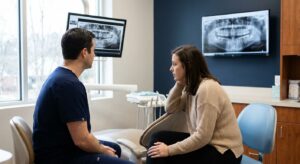
At View Dental Raleigh, the conversation starts with what you ultimately want to accomplish. You might want to be out of pain this week. You might want to chew on both sides again, or feel comfortable smiling in photos. The dentist explains the clinically ideal option first, so you can make decisions knowing what is possible. Then the dentist listens to your health, goals, timing, finances, insurance benefits, and ability to maintain the treatment. Your plan is built from those answers.
What does a phased plan look like, step by step?
A phased plan addresses the most urgent problems first and prices each phase on its own, so you can handle one portion at a time instead of the full balance upfront. At View Dental Raleigh, the sequence moves from infection and pain, to the other teeth that cannot be restored, to restorative or denture work once your mouth is stable, with implants considered when you are ready.
According to the Centers for Disease Control and Prevention, more than 1 in 4 U.S. adults has untreated tooth decay, which is one reason the first phase so often starts with infection and pain.
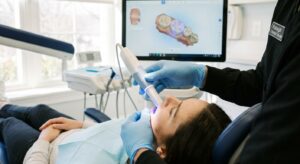
Before you hear any opinion, you see what the dentist sees. Intraoral photographs, X-rays, and digital scans are shown to you first, so the diagnosis is something you can look at rather than something you have to take on faith. From there, the plan usually runs in this order:
- Phase one removes teeth with active infection, pain, swelling, or the greatest risk of causing an emergency.
- Phase two addresses the remaining teeth that cannot be restored.
- Phase three is the restorative or denture phase: fillings, crowns, bridges, or a partial or full denture once your mouth has healed and stabilized.
- Phase four considers implants when your bone, health, and budget line up.
Each phase is priced separately, based on the number and complexity of the extractions and your insurance benefits. One privately insured patient needed full mouth extractions but could not afford the entire copay at once. Instead of delaying all care, the practice divided the extractions by urgency and priced each group on its own. That patient was able to handle one portion at a time while the teeth posing the greatest risk were treated first.
You leave with a phased roadmap, so you know what comes next, roughly when, and why it sits in that position. This is what looking beyond the tooth that hurts today means in practice. The practice is not simply trying to fix one problem and move on.
Can a partial denture bridge the gap until implants?
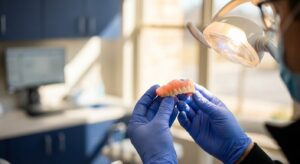
It can be an option. A flexible partial denture can help restore appearance and chewing function while implants are planned for later. It is removable, it needs daily care and occasional adjustment, and it is not the same as implants. For some patients on a limited budget, it may be a reasonable middle step. Missing teeth are common: the Centers for Disease Control and Prevention reports that nearly 1 in 5 adults aged 65 or older has lost all of their teeth.
The wedding patient’s experience shows how this can work for one person. What began as an emergency visit revealed extensive decay, several broken and infected lower premolars, and multiple missing back teeth that affected both her chewing and her confidence. Her immediate goal was to get out of pain. Her ultimate goal was to smile at her wedding. Implants were the long-term option the dentist discussed, but they were not financially realistic for her yet.
So the team separated the ideal destination from the most appropriate immediate path. First, they removed the broken, infected teeth that could not be predictably saved. Next, they restored the teeth that could be maintained. Finally, an aesthetic flexible partial denture replaced the missing back teeth, including the new spaces from the extractions. Her care was scheduled as a series of coordinated visits around the wedding date, and she left with a plan for implants once she is financially and personally ready.
The partial was never presented as equivalent to implants. The dentist explained its benefits, limitations, maintenance needs, and removable nature. Here is what that means for you:
- You take it out to clean it.
- It may need adjustments or a reline over time.
- It does not hold your bite the way an implant does.
Its value for her was that it addressed the immediate concerns without closing off future options. Her case is shared on the practice’s Instagram.
What drives the real cost of a dental implant?
The cost of a dental implant is the sum of several parts: the exam and imaging, any extraction, any bone grafting, the implant itself, the abutment that connects it, and the crown on top. If you need teeth in the meantime, add a transitional partial. That is why View Dental Raleigh gives a meaningful total only after the exam and 3D imaging.
Each part changes for a reason:
- Extraction: a tooth that breaks below the gumline or has deep infection takes more work to remove than one that comes out cleanly.
- Bone grafting: this may be needed when infection or years of missing teeth have thinned the bone.
- Staged versus immediate placement: the CBCT shows the height and width of your bone and the position of your sinus and nerves. Those findings help decide whether the implant can go in on the same day as the extraction or needs a staged approach with more visits.
- Restoration: the crown, bridge, or denture on top depends on how many teeth you are replacing.
Prices also differ by location. A U.S. Government Accountability Office review found that fees for the same dental procedure vary widely from one area to another. A quote from another city tells you little about your own case in Raleigh, which is one more reason the estimate should come from your own exam.
Careful planning is part of what you are paying for. Published clinical studies commonly report implant survival rates above 90 percent at ten years, and that long-term outlook depends on bone, health, and placement decisions made up front.
At View Dental Raleigh, the CBCT scan used to plan an implant case is complimentary. During the consultation, the practice shows you the total treatment investment first and only then reviews monthly options. A low monthly payment without the total behind it does not tell you the actual price.
Which lower-cost paths may fit a budget?
Once you know the cost drivers, the next question is which kind of implant treatment may fit your budget. There are three lower-cost paths the practice can discuss:
- A single implant in the spot that matters most for chewing
- An implant bridge that replaces several teeth using fewer implants
- A snap-in implant-supported denture that holds a denture in place
View Dental Raleigh places and restores all three. Full-arch fixed cases are referred to an oral surgeon partner.
A single implant in a key chewing position may restore some function without replacing every missing tooth at once. Snap-in dentures may be a practical step up for someone who already wears a denture and is tired of movement or adhesive.
Timing affects both cost and comfort. An implant may be placed on the same day a tooth is removed, but only when the bone is healthy, infection is controlled, and the implant achieves good initial stability. During surgery, the dentist measures insertion torque, which shows how firmly the implant grips the bone. An immediate restorative approach may be considered at roughly 35 Ncm or higher, together with favorable bone, gums, and bite. If the implant falls short, the dentist does not force it to shorten treatment. The implant gets more healing time first.
Implants are not the right choice for every person. Depending on your gums, bone, and finances, a well-made bridge, partial, or denture may be a more suitable path. The practice tells you that directly, because it does not believe the most expensive or most aggressive treatment is automatically the right one.
Does Medicaid help pay for implants in Raleigh, and how else can you pay?
View Dental Raleigh accepts Medicaid, and Cherry and cash pay are ways to pay. Medicaid’s adult dental coverage varies, though, so do not assume it includes implants. Ask the office to review what your specific plan covers before you build a budget around it.
The GAO’s report on dental coverage describes how adult dental benefits under Medicaid differ from state to state. Coverage for extractions, dentures, and implants is not uniform. These are the ways to pay on record at View Dental Raleigh:
- Medicaid: accepted. Bring your card and ask what your plan covers for adult care.
- Cherry: a way to pay. Ask the office how it applies to your treatment.
- Cash pay: you can pay for one phase at a time as you go.
Cherry and cash pay are ways to pay, not insurance. If you have a different dental plan, bring the card so the team can tell you how it applies. The federal guide Finding Low-Cost Dental Care also outlines public options worth knowing about.
There is one more thing a stranger reading this would not guess. When a patient urgently needs more teeth removed than they can reasonably afford, the practice has occasionally reduced or waived part of its fee so that infection is not left untreated. This happens case by case. It is not an advertised offer and never a promise.
Why consider View Dental Raleigh for a budget-conscious implant plan?
When you are asking how a person on a limited budget can afford dental implants, you may also be asking whether a smaller budget means cutting corners. At View Dental Raleigh, every implant case is planned around the final tooth being replaced, not simply around where there happens to be bone, and that planning approach is the same whether you start with one phase or the whole roadmap.
The practice uses technology where it helps the plan:
- CBCT imaging to evaluate bone and anatomy in three dimensions
- Digital intraoral scans in place of traditional impressions where possible
- Guided implant surgery with a custom surgical guide when anatomy is limited or several implants are planned
Not every implant needs a guide, so the approach is chosen case by case rather than used the same way for every patient.
Many patients arrive with dental work that was done one tooth at a time, with no plan for the rest of the mouth. The practice does not criticize the previous dentist. It keeps what is healthy, addresses what is no longer predictable, and builds a customized plan around the whole picture. Some patients have said they felt listened to rather than judged or rushed. For someone who has avoided care for years, that can matter as much as the clinical work.
View Dental Raleigh serves adults across Raleigh, including readers near Cameron Village who are searching for an affordable dentist. The wedding patient drove more than an hour for each appointment because the plan fit her budget and her timeline. You can see more of what the practice offers on the View Dental Raleigh website.
Where is View Dental Raleigh, and what happens at a first visit?
View Dental Raleigh is in Raleigh, NC. For the current address and office hours, check the practice website, and ask the scheduling team about the next available appointment, including for emergencies.
A family dentist typically handles exams, cleanings, fillings, and urgent problems for the members of a household. View Dental Raleigh provides comprehensive care under one roof for adults and refers children to a pediatric dentist. A spouse, grown son or daughter, or older parent who helps with decisions or payment is welcome to sit in while your plan is reviewed.
Services offered:
- Adults: exams, cleanings, oral cancer screenings, tooth-colored fillings, crowns, bridges, root canal therapy, extractions, full and partial dentures, denture adjustments and relines, dental implants, implant-supported dentures, and clear aligners
- Kids: referred to a pediatric dentist
- Emergencies: emergency appointments, pain relief, and care for infected or broken teeth
How to book and what to expect:
- Contact the office through the View Dental Raleigh website to request a new patient visit.
- Bring your ID, your Medicaid card or other dental plan information, and a list of your medications.
- Complete an exam, X-rays, and intraoral photos, plus a CBCT scan if implants are being considered.
- Review your images with the dentist and talk through your goals.
- Receive a phased plan that shows the total before any monthly payment.
- Schedule phase one, starting with the most urgent need.
Can anxious patients get comfort options at the dentist, such as headphones?
You can ask. When you book, ask whether you can bring your own headphones or earbuds and let the team know you would like to use them. The office does not offer sedation dentistry, nitrous oxide, or IV sedation, so comfort comes from how your visit is planned and paced.
You see your photos and scans before anyone recommends treatment. Urgent problems are separated from issues that can be addressed over time, so you are not handed everything at once. You can also ask to slow down or take a break during treatment.
If fear is the reason you have waited, say so at the start. That is information the dentist uses to plan your care, not something you will be judged for.
What else do Raleigh adults ask before starting an implant plan?
Can I get dental implants with no money upfront?
Implants are not free. Phasing your care and paying one phase at a time with Cherry or cash may help spread out the cost. The office can explain your options after an exam.
Does Medicaid cover dental implants in North Carolina?
Adult dental coverage varies, so do not assume implants are included. Check with NC Medicaid and ask the office to review what your plan covers.
Is a partial denture a good stepping stone before implants?
It can be for some people. A partial may help restore appearance and chewing while implants are planned. It is removable, needs maintenance, and is not the same as implants.
Why do I need a 3D scan before getting a price?
The CBCT scan shows your bone and nerve positions. Those findings help determine whether you may need grafting or staged placement, and that can change your total.
Does View Dental Raleigh offer full-arch implants?
Full-arch cases are referred to an oral surgeon partner. The practice places and restores single implants, implant bridges, and snap-in dentures.
What should I do first if I have a painful, infected tooth?
Have the infection and pain evaluated and treated first. That protects your health, and it is also the first phase of a budget-conscious plan.
What is a usable implant estimate you can fill in yourself?
A usable estimate is one you build line by line from your own consultation and add up before you ever look at a monthly payment. Write each of these lines on a sheet and leave a blank beside it:
- Exam and CBCT scan
- Extractions
- Bone grafting
- Implant
- Abutment
- Crown
- Transitional partial denture
Fill in each figure only from your exam, and note which phase it belongs to. Add the phases together to get your total. Only after you see that total should you divide it by any payment terms you qualify for. If one phase is all you can manage right now, circle it and start there.
So, how can a person with a limited budget approach dental implants? Often by not trying to buy everything at once. Book a new patient exam and complimentary 3D scan at View Dental Raleigh, ask for a phased plan that shows the total before monthly payments, and bring your insurance or Medicaid card so the team can review what applies. The most useful thing you can bring is one sentence about what you ultimately want to accomplish, because that is where your plan begins.
Your Smile Plan Can Start Small
If dental implants feel out of reach right now, you are not alone, and a phased plan means you do not have to solve everything at once. The team at View Dental Raleigh can look at your mouth, talk through what matters most to tackle first, and help you map out realistic steps that fit your situation. Call the office to take that first conversation, with no pressure to decide anything today.
Individual experiences vary. This article is general information, not a diagnosis or treatment recommendation. Your options depend on an in-person exam and imaging.