Dental Implants in Raleigh: Planning, Placement, and Restoration Under One Roof
Your consultation ends with two pieces of paper. One is a referral to an oral surgeon across town who will place the implant. The other is a note to come back in a few months so a different dentist can attach the crown. Nobody has clearly explained who makes sure the implant lands where your new tooth actually needs to sit. That split is common when people research dental implants in Raleigh, and it is why we built our implant care differently at View Dental Raleigh. Here, single-tooth implants, implant-supported bridges, and snap-in implant supported dentures are planned, placed, and restored in the same office by the same dentist, using the Neodent implant system.
This guide covers what an implant is and how we plan your case with a complimentary CBCT 3D scan. It also covers when an implant can go in the same day a tooth comes out, what the full cost includes, and what affects individual results. Our goal is for you to understand the whole path before you commit to any part of it. If you feel uneasy about how your teeth look right now, or you worry about pain or being pushed into treatment, bring those concerns to the conversation. They help us plan care that fits you.
What Is a Dental Implant, and Why Does Replacing the Root Matter?
A dental implant is a complete tooth replacement. It restores both the root below the gumline and the crown you see and chew with. Because the root is replaced, the implant anchors in your jawbone, keeps that bone engaged, and feels stable when you bite. A bridge or partial denture cannot do that because it rests on neighboring teeth or on the gums.
An implant has three parts. First, a small post is placed into the jawbone, where it takes the place of the natural root. We then attach a connector called an abutment, which rises just above the gumline. Finally, we design and seat the crown, the part that looks and works like a tooth.
A fence post is a useful comparison. A post set firmly in the ground stands on its own, while a board leaning against the posts beside it depends on them to stay upright. A traditional bridge works more like the leaning board, because the teeth on either side are usually reshaped to hold it. A partial denture depends on clasps and on the gums underneath.
The root matters for another reason. Jawbone stays healthy partly because tooth roots put gentle pressure on it every time you chew. When a tooth is lost and nothing replaces the root, the bone in that area can slowly shrink. This is one reason a long-standing gap can become harder to treat over time. It is also why an implant may be an option worth considering for replacing posterior teeth, the molars and premolars that take the most chewing force, though individual factors always apply.
At View Dental Raleigh, three implant treatments stay entirely in-house: single-tooth implants, implant-supported bridges, and snap-in implant supported dentures. When your scan shows a site needs more bone before an implant can go in, we handle the bone grafting here as part of your plan. Fixed full-arch treatment, often called All-on-X, is different. We do not perform full-arch surgery or immediate-load full-arch teeth in our office, so for those cases we refer you to our oral surgery partner. For the implant cases we treat here, you do not have to coordinate between offices for the surgical and restorative phases. The dentist who plans your implant is the same one who builds the tooth on top of it.
Implants are not the only answer, and we will not pretend they are. Some patients want to explore options that may offer greater stability. Others need a more budget-conscious phased plan that starts with a bridge or a denture. When cost or health makes an implant unrealistic today, we can often choose a path that keeps the door open for implants later.
Why Should Your Implant Be Planned Around the Final Tooth Instead of the Available Bone?
Your implant should be planned around the final tooth because the implant exists to support that tooth. If the post goes wherever bone happens to be convenient, the crown on top can end up angled, oversized, or hard to clean. So we start with the end goal: how your new tooth should look, how it should function in your bite, and where it needs to sit in your smile. Then we work backward.
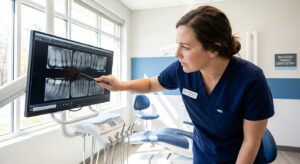
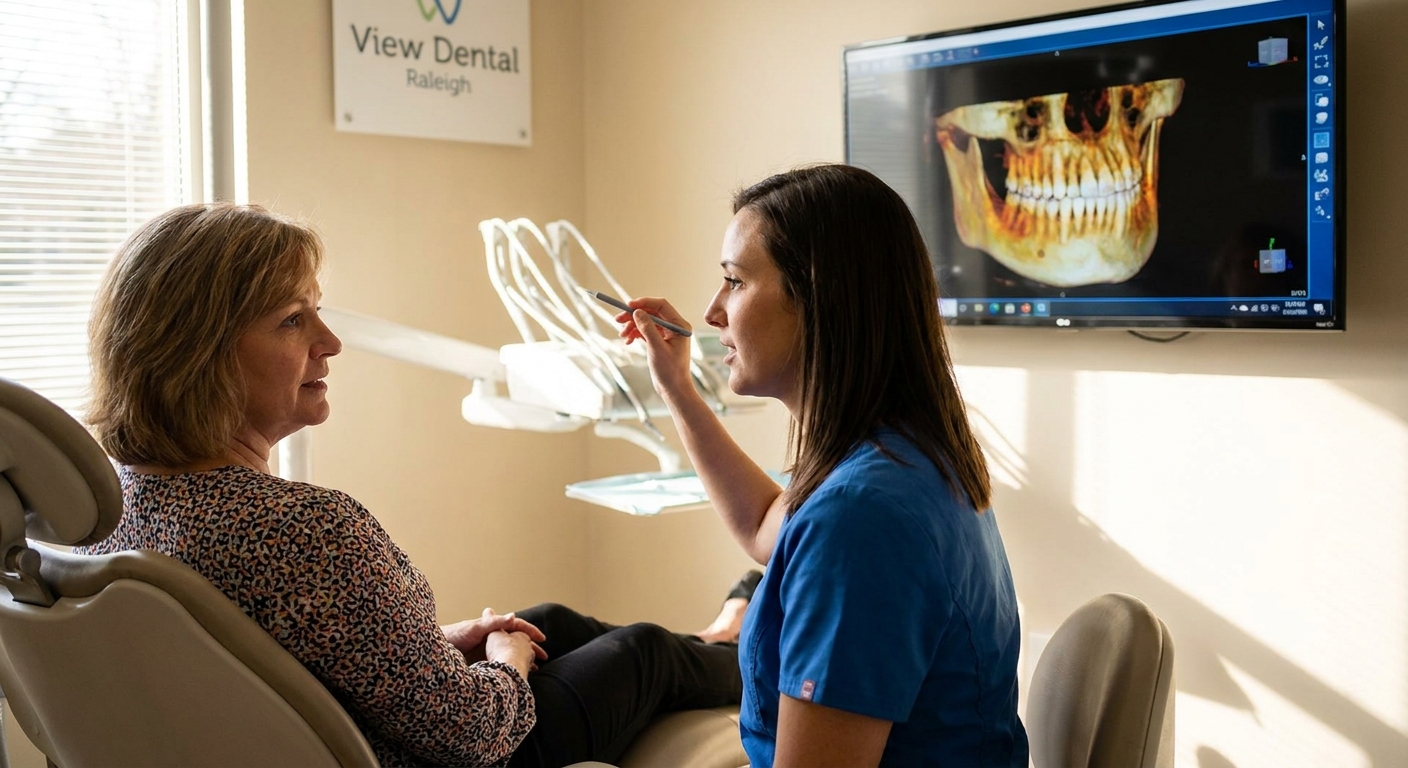
A standard dental X-ray is a flat picture. A CBCT (cone beam computed tomography) scan is a three-dimensional image of your jaw, and we take it at no charge to plan your case. It lets us measure the height and width of your bone and find the nerve that runs through the lower jaw. It also shows where your sinus sits above the upper back teeth and the shape of an extraction socket, and it helps us judge whether there is enough healthy bone to support implant placement. We pair the CBCT with a 3D intraoral scan of your teeth and bite, which also replaces messy traditional impressions. With both scans side by side, the surgical side and the restorative side of your case are studied together before treatment begins. This is where advanced technology earns its place: it replaces guesswork with measurements.
Think of it like building a house. An architect draws the house first and then decides where the foundation must go to hold it up. If you pour the foundation first and design the house to fit it, you end up with compromises. Implants work the same way.
Suppose you are missing a lower molar. The CBCT might show that the nerve sits closer to the top of the bone than expected, or that the bone is narrow on one side. With that information, we choose the implant size, depth, and angle that supports the crown in the right spot while staying a safe distance from the nerve. On an upper molar, the same scan tells us whether the sinus is close enough that the site needs additional bone support.
When extra precision would help, such as limited anatomy, multiple implants, or a case where the implant must closely follow the planned crown, we use guided implant surgery. Neodent offers a dedicated guided surgery workflow for its Grand Morse implants. We send your CBCT and scan data to a third-party laboratory that specializes in implant planning and guide fabrication. Their team proposes implant positions, and our dentist reviews that plan with the planner: angulation, depth, spacing, bone, nearby anatomy, and whether each implant truly supports the final tooth. If something needs to change, the digital plan is adjusted before the guide is made. The lab adds a second set of expert eyes, while every clinical decision stays with your dentist. Not every implant needs a guide, so we choose the approach case by case.
Our typical implant workflow looks like this:
- Comprehensive dental and bite evaluation
- Digital X-rays and a complimentary CBCT scan
- 3D intraoral scan and restorative planning
- Evaluation of bone, gums, neighboring teeth, and important anatomy
- Decision between immediate placement and a staged approach
- Bone grafting when needed
- Implant placement, with guided surgery when beneficial
- Healing and monitoring
- Final crown, bridge, or implant supported denture once the implant is ready
This is what comprehensive care under one roof looks like in practice. The person reading your scan is the same person designing your crown, so the plan does not change hands halfway through.
Can Your Implant Go In the Same Day the Tooth Comes Out?
Sometimes it can, but not always. Immediate implant placement means the implant goes in at the same visit the tooth is removed. It may be possible when the remaining bone is healthy, the implant can anchor firmly beyond the socket, the gum tissue is favorable, and infection or bone loss is not making healing unpredictable, though individual factors vary. When those conditions are not present, a staged approach is usually considered.
We make this decision before the tooth comes out. Using the clinical exam and your CBCT, we look at the bone around the tooth, any infection, the gum tissue, and whether we are likely to get stable anchorage past the extraction socket. If the tooth can be removed carefully, the bone is favorable, and the implant can be placed in the correct three-dimensional position with good primary stability, immediate placement may be considered.
Significant bone loss, unfavorable anatomy, or a site that would heal more predictably after grafting will likely lead us to recommend staged treatment. First, the tooth is removed and the site is grafted. We let the graft heal, then check the site again before placing the implant into bone that is ready for it.
A tent stake is a fair comparison. Pushed into firm ground, it holds right away. Pushed into loose, wet soil, it pulls out under tension. You would wait for the ground to settle rather than hope it holds.
We also measure stability during surgery. Insertion torque tells us how firmly the implant grips the bone as it goes in. When we reach approximately 35 Ncm or greater, along with favorable bone, implant position, soft tissue, and bite conditions, we may consider an immediate restorative protocol when clinically appropriate. That number is only one part of the decision. If the implant falls short of the stability we want, we do not force an immediate tooth just to shorten treatment. We give it more healing time before it takes chewing force.
If surgery makes you nervous, oral sedation with Valium is available when appropriate. We do not offer IV sedation or nitrous in our office, so if you need deeper sedation, we will talk that through during treatment planning.
This matters most when you arrive with infected and broken teeth. Your first need may be getting out of pain, and that comes before the long-term plan. Part of our job is separating the ideal destination from the most appropriate immediate path. Removing a nonrestorable tooth and grafting the site today, then placing the implant after healing, is not a detour. It can be a predictable way to reach the same final tooth.
What Does the Full Investment for Dental Implants in Raleigh Actually Include?
The full investment for a single implant can include more than the implant itself. Depending on your case, it may include an extraction, bone grafting, the implant, the abutment, and the final crown. Because every site is different, we complete the exam and 3D imaging before giving you a meaningful total price and monthly estimate.
A quoted number means little if it leaves out half the treatment. A healthy site where the tooth has been gone for a while may only need the implant, abutment, and crown. A site with a broken tooth still in place may need a careful extraction first. A site with thin bone may need grafting before the implant goes in, which adds cost and healing time. Your CBCT shows us which of these applies, so the number you receive reflects your real case instead of a low estimate that grows once treatment starts.
Larger cases vary even more. For implant supported dentures, the total depends on how many implants are needed, whether teeth need to be removed, how much bone is available, the type of temporary and final restoration, and whether one arch or both are treated. During your consultation, we walk through the benefits, limitations, maintenance, timing, and cost of each realistic option so you can compare a single implant, a bridge, a denture, and implant supported options side by side.
For financing, we offer third-party options including CareCredit and Cherry, which may let qualified patients split treatment into monthly payments. Approval and terms depend on the treatment and the option you qualify for. We also welcome cash-pay patients. Our order of operations is deliberate: you see the total treatment investment first, and only then do we review monthly payments. We do not want to advertise a low monthly payment without explaining the actual total cost behind it.
Insurance is its own conversation. Implant coverage varies widely, and many plans limit or exclude implant procedures, so do not assume anything is covered until it is confirmed. View Dental Raleigh accepts Medicaid, and you can look up participating dentists through the NC Medicaid dental provider directory. Accepting a plan does not mean every procedure is covered, so bring your benefit information to your visit and we will review how it may apply.
How Long Do Dental Implants Last, and What Affects Your Result?
Dental implants have a strong track record in published research, particularly when they are placed in healthy bone and properly maintained. Your own result still depends on factors specific to you, and responses to treatment vary from person to person.
The factors that matter most include bone quality and maintenance. Bone quality affects how well the implant fuses and holds. Daily brushing and flossing protect the gum tissue around the implant, which can become inflamed just like gums around natural teeth. Smoking slows healing and is linked to a higher risk of implant complications. Conditions such as uncontrolled diabetes can affect how bone and gums respond after surgery. Your bite matters too. If you clench or grind, the forces on an implant crown need to be managed, which is part of why we plan the bite along with the implant.
Care after your crown is placed is not complicated, but it is ongoing. You brush and floss around an implant much like a natural tooth. You also keep regular cleanings and checkups so we can watch the gum and bone around the implant, check the bite, and catch small issues early. An implant cannot get a cavity, but the tissue that holds it still needs attention.
Your treating dentist has advanced implant training through the Misch International Implant Institute, which teaches surgical planning, bone grafting, immediate placement protocols, and implant-supported prosthetics as part of its comprehensive curriculum. The reasoning is simple: implant dentistry is not something you learn from a single weekend course. Doing it well means understanding bone, implant position, the bite, prosthetic design, complications, and maintenance together, rather than treating surgery and restoration as separate jobs.
So when you compare options for dental implants in Raleigh, look past titles and technology. Ask how much implant-focused education the dentist has completed. Ask how the surgical and restorative parts of your case are planned together, how complications are handled, and who is responsible for your care from start to finish. You can also ask to see documented before and after cases. During your consultation, we can walk you through real cases from our office, such as a patient with a broken or missing tooth, following the starting condition, the CBCT planning, placement, healing, and the final implant-supported tooth. That shows you how we evaluate cases, not only individual results. Patients tell us they want to be treated like a person, not just another procedure, and seeing the whole process is part of that.
Questions Raleigh Patients Ask Before Committing to an Implant
Most patients ask the same practical questions about timing, gaps, insurance, bone, and care. Here are straightforward answers, with the understanding that your exam and imaging will shape the details.
How long does the entire dental implant process take from consultation to final crown?
The timeline depends on whether you need an extraction or bone grafting first. Once the implant is placed, it commonly needs several months, often three to six, to fuse with the bone before the final crown goes on, though healing varies by patient. Grafted sites usually need extra healing time before the implant can be placed.
Will I have a gap in my smile while the implant heals?
In many cases, no. Depending on the location and your implant’s stability, we can discuss temporary options, such as a temporary restoration or a partial denture, to fill the space while you heal. We plan this with you before treatment so you know what to expect.
Does dental insurance cover any part of the implant cost?
It depends on your plan. Some plans help with parts of treatment, such as an extraction or crown, while implant coverage itself varies widely and is often limited. View Dental Raleigh accepts Medicaid, and you can confirm participating dentists through the NC Medicaid Dental Providers page. Bring your benefit details and we will review them with you.
What happens if I do not have enough bone for an implant?
If your CBCT shows the bone is too thin or too short, we can often rebuild the site with a bone graft in our office before the implant is placed. This adds time, but it can provide the implant with a better foundation.
Can I get more than one implant at the same appointment?
Yes. Multiple implants can often be placed in one appointment when your plan involves replacing several teeth or supporting a bridge or snap-in implant supported denture. Guided surgery is especially useful here. Fixed full-arch cases are referred to our oral surgery partner.
How do I care for a dental implant once the crown is placed?
Brush and floss around it like a natural tooth, and keep up with regular cleanings and checkups. Those visits let us monitor the gum and bone that support the implant over time.
Before your visit, decide what matters most to you right now. That might be chewing comfortably on that side, how the tooth looks when you smile, keeping treatment within a certain budget, or finishing within a certain timeframe. That one priority changes how we weigh immediate versus staged placement, which restoration fits best, and how a phased plan might be sequenced. When you tell us up front, our planning starts from your answer instead of a one-size-fits-all script.
Schedule an implant consultation at View Dental Raleigh that includes a complimentary CBCT 3D scan. You will see your bone anatomy on screen, understand which implant options fit your situation, and receive a clear total cost before you commit to any treatment.
Ready to explore whether dental implants are right for you?
If you’ve been living with missing teeth or struggling with dentures, it may be time to learn what’s possible. The team at View Dental Raleigh can walk you through the planning, placement, and restoration process in one conversation,no pressure, just clear answers. Give us a call to schedule your consultation and take the first step toward a complete, confident smile.
Individual results with dental implants vary and depend on many factors including bone quality, maintenance, overall health, and compliance with post-treatment care.