You drop your denture into the bathroom sink while rinsing it, and a section of the acrylic base cracks clean through. You have a family dinner tonight and a presentation at work tomorrow, and going without teeth for even one day feels impossible. Your first question is whether anyone in Raleigh can fix it today. Your second is whether you should try glue or just call the dentist. If you typed “denture repair near me” into your phone a few minutes ago, this guide from View Dental Raleigh gives you the shortest safe path from a broken appliance to a working one. It also explains how to keep the damage from getting worse before you arrive.
Start by putting the glue away. Many clean breaks can be repaired chairside in one to two hours. Other breaks need a dental lab for two to five business days, and some mean the denture has reached the end of its useful life. Your goal right now is to figure out which situation you are in, get to the right office with every piece intact, and leave with either a working denture or a clear plan. That plan should include a timeline and a cost estimate you understood before any work began.
Before you start, gather these:
- The broken denture and every fragment, including small chips
- A clean, dry container with a lid, or a zip-top bag
- Your insurance or Medicaid card and a photo ID
- A current list of your medications
- Your phone, so you can call as early in the day as possible
Expected outcome: If you follow the five steps below, you will either leave the same day with a repaired denture, or you will know exactly what kind of repair or replacement you need, how long it will take, and what it will cost.
What Breaks Qualify for Same-Day Denture Repair Near Me (and What Doesn’t)?
A clean break in the acrylic base, or a single lost clasp on a partial, often qualifies for same-day repair if the pieces fit together precisely and your gums were not injured. A warped denture, multiple fractures, or a break through a tooth usually requires a lab or a new appliance.
The deciding factor is accuracy. A chairside repair works by rejoining the original pieces in their original position and bonding them with new acrylic resin. When the broken edges line up like puzzle pieces, with no gap and no missing chips, the dentist has a precise guide to work from. When the edges are crumbled, the piece is bent, or part of it is missing, there is nothing reliable to line up. In that case the repair has to be rebuilt on a model in a lab.
| Type of damage | Usually same-day? | Why |
|---|---|---|
| Single clean crack through the base | Often yes | Pieces realign precisely |
| One tooth popped off intact | Often yes | Tooth can be rebonded in place |
| One lost or broken clasp on a partial | Often yes | Limited, localized repair |
| Warped base (from heat or hot water) | Usually no | Shape has changed, and bonding cannot restore the fit |
| Several cracks or stress lines | Usually no | Structure is weakened in more than one area |
| Break running through a tooth or missing fragments | Usually no | Needs lab rebuilding or a new appliance |
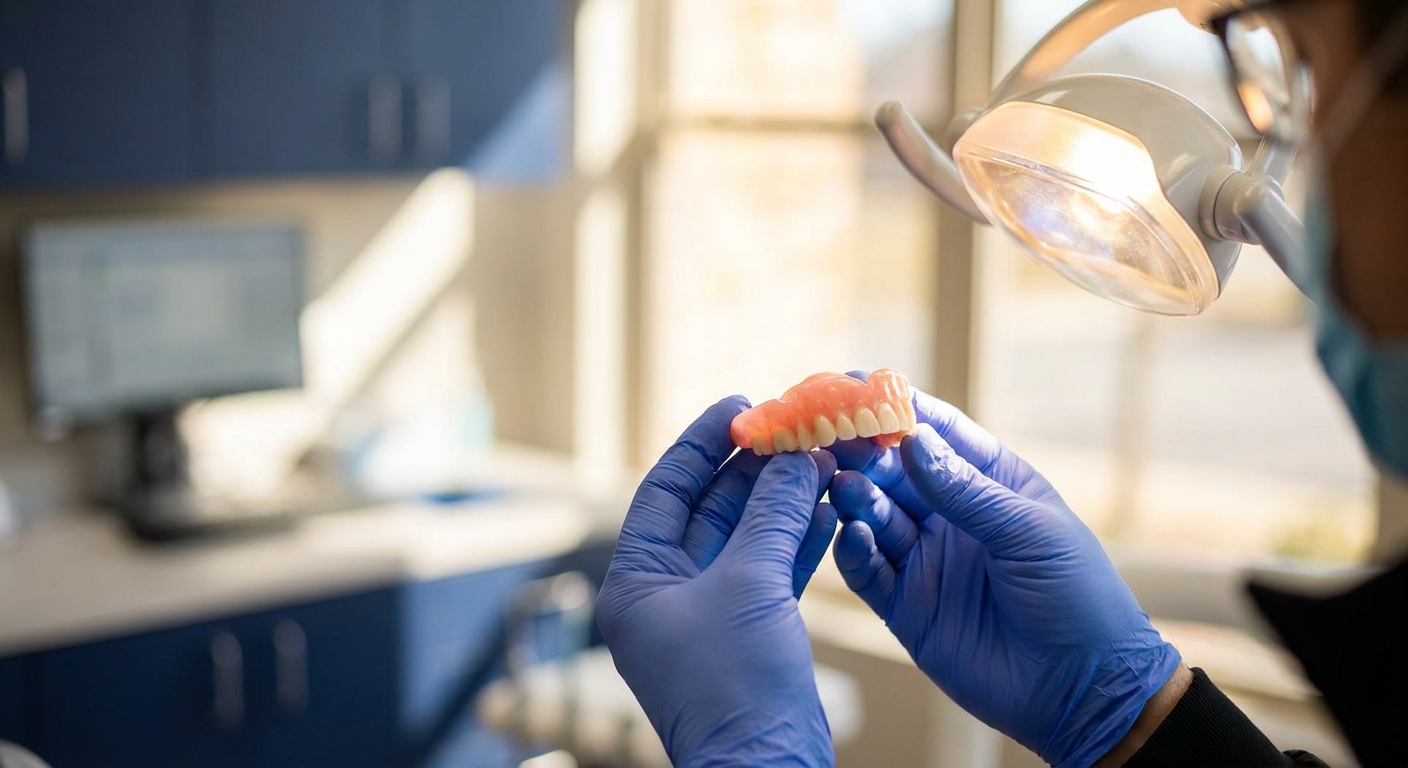
Here is a practical test you can do at home. Hold the two halves together gently under good light. If they click into place and the seam nearly disappears, that is a promising sign. If you see a gap, a step where one side sits higher, or a missing chunk, expect a longer path.
There is a second clue worth considering. If this is the same crack in the same spot for the second time this year, the break itself is probably a symptom. Something about the fit or the bite is putting stress on that area. Looking beyond the crack you can see today is what keeps it from happening a third time.
Can’t You Just Superglue It? Why Home Fixes Make Repair Harder
Superglue and drugstore repair kits usually make a broken denture harder, and sometimes impossible, to repair properly. The American Dental Association’s denture guidance points denture wearers to their dentist for adjustments and repairs rather than do-it-yourself fixes.
The temptation makes complete sense. It is Saturday night, the pieces look like they fit, and the glue is in the kitchen drawer. The problem is that household adhesive is not made for the inside of your mouth. Even a very thin layer between the pieces shifts their alignment slightly, and that small shift changes how the base sits against your gums. You may not notice it at first, but your tissue will, usually as a sore spot within a day or two. The chemicals in these products can also irritate the soft tissue the denture rests on.
Durability is the next problem. Moisture, warmth, and chewing pressure all work against a household bond, so it often lets go quickly, sometimes during the very dinner you were trying to save. By then the glue has soaked into the fracture line. Before a dentist can repair it properly, that glue has to be ground away, along with some of the acrylic that would have helped the pieces line up. A repair that might have been simple can turn into stripping the base and rebuilding it, which takes longer and costs more.
Drugstore kits carry the same risk with a bit more effort. You are still aligning the pieces by eye in a bathroom mirror, with no way to check the fit or your bite. Going without your denture for a day is genuinely uncomfortable, and nobody wants to show up to work that way. A better short-term plan is to keep the pieces safe, eat soft foods, and call first thing in the morning.
Step 1: Call Before Noon and Describe the Damage Over the Phone
Once you have set the glue aside, your first real step is the phone call. Call as early in the day as you can and describe exactly what broke. The front desk at View Dental Raleigh will likely ask what broke, whether the pieces fit together, and whether you have any pain or swelling. Calling early, and asking whether the office repairs dentures in-house or sends them to a lab, gives you the best chance of leaving with a working appliance the same day instead of waiting two to five business days.
Each question has a purpose. “What broke” tells the team whether this is a base fracture, a lost tooth, or a clasp, which are very different jobs. “Do the pieces fit together” is the best early predictor of a chairside repair. “Any pain or swelling” separates an urgent tissue problem from a purely mechanical one. If a sharp edge cut your cheek, or you have swelling or a sore that is not healing, say so clearly. That changes the priority of your visit, and it should.
Calling earlier matters because chairside repairs take real time, and a one-to-two-hour repair is much easier to fit into a schedule that still has the afternoon open. When you call View Dental Raleigh, ask these questions so you do not waste a trip:
- Can you see me today, or first thing tomorrow?
- Is this kind of repair done in the office, or sent to a lab?
- What is the typical cost range for this type of break?
- Do you accept my insurance or Medicaid, and can you check my benefits before I come in?
- What should I bring?
You deserve straight answers to all five. If the honest answer is that your break sounds like a lab case, it is better to hear that on the phone than in the chair. Knowing the timeline up front lets you plan meals, rearrange tomorrow’s presentation, or find an older denture before you leave the house.
Step 2: Gather Every Piece and Store Them in a Clean, Dry Container
After the call, turn your attention to the pieces themselves. Put every piece of the denture, including small chips, in a clean, dry container and bring all of it with you. Do not rinse the pieces in hot water, do not try to force them together, and do not wrap them in tissue that will leave lint or fibers in the fracture line.
Each of those rules protects something specific. Hot water can soften and warp denture acrylic, and a warped base cannot be fixed by bonding the pieces back together. If the pieces need a rinse, use cool water and let them air dry. Forcing the pieces together grinds the fracture edges against each other. Those edges carry a matching pattern, almost like a fingerprint, that lets the dentist realign the parts precisely. If you rub that pattern away, the repair becomes less accurate.
Tissue paper and paper towels seem harmless, but they leave fibers caught in the crack. Those fibers sit between the old acrylic and the new resin and weaken the bond. A small plastic food container with a lid works well, and so does a zip-top bag. If you can, place each large piece in its own bag so they do not knock against each other during the drive.
Before you leave, check the sink, the counter, and the floor for missing fragments, and look in the drain trap if you can reach it safely. A missing chip from the edge of the base can turn a same-day repair into a lab case, so it is worth five minutes of searching. If you wear a partial and only a clasp broke, ask the front desk whether it is safe to keep wearing it until your visit. Do not wear any denture with a sharp, jagged edge that rubs your gums or cheek.
Step 3: Arrive With Your Insurance Card and a List of Medications
With the pieces packed, take a moment to gather your paperwork. Bring your insurance or Medicaid card, a photo ID, and a current list of your medications. View Dental Raleigh accepts Medicaid, Cherry financing, and cash pay. Having your card in hand lets the front desk verify benefits and give you a realistic estimate before the dentist examines the appliance.
The money question is often the biggest worry for someone with an urgent break, and it is a fair one. Many people fear that a simple repair visit will turn into a large treatment plan they never agreed to. At View Dental Raleigh, the approach is to separate urgent problems from issues that can be addressed over time. Your immediate goal is a denture that works this week. If the dentist sees something that deserves a longer conversation, you will hear about it, along with the benefits, limitations, expected maintenance, timing, and cost of each option. The decision stays yours.
Medicaid benefits vary by plan, so the front desk at View Dental Raleigh will check what your plan includes before work begins rather than guessing. Cherry is a financing option, not insurance. It lets you spread a cost over time if the repair costs more than you expected or if the conversation turns to a new denture.
The medication list matters more than most people realize. Many common medications cause dry mouth, which makes dentures rub and sore spots more likely. Blood thinners are worth knowing about if any tissue near the break needs attention. Health conditions such as diabetes can slow the healing of irritated gums. And if you have ever reacted to dental materials, the dentist needs to know before any resin goes near your mouth.
Step 4: Let the Dentist Examine the Fracture and Your Gums
Before any repair, the dentist examines the fracture, checks how the denture fits, and looks closely at your gums and the ridge underneath. A repair is only as good as the fit it sits on. A quick glue-and-go fix without that exam is how people end up back in pain a week later.
At View Dental Raleigh, that exam is done by a DMD whose advanced clinical education goes well beyond the basics. The dentist has logged hundreds of hours of implant-focused continuing education and has put more than $100,000 into advanced training in surgery, restorative planning, and complex full arch cases. For you, that background means the person looking at a cracked base is trained to read the whole mouth it sits in: the ridge, the bite, and the forces that caused the break.
During your exam, the dentist works through three questions. Can this fracture be predictably repaired? Has the fit changed enough that a realign belongs in the plan? And does gum irritation or bone loss mean a new denture is worth discussing down the road?
Your gums matter because they change. After teeth are lost, the bone and tissue under a denture gradually shrink and reshape. A denture that fit well three years ago may now rock, rub, or concentrate pressure on one spot, and that uneven pressure is a common reason dentures crack in the first place. If your tissue is inflamed or has a pressure sore, the dentist may recommend letting it settle before any refitting. Fitting a denture to swollen tissue produces a poor fit once the swelling goes down.
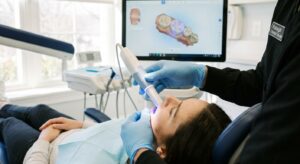
When it helps, the team uses digital X-rays to look at the bone beneath the denture. A sore that will not heal also gets a careful look, and oral cancer screening is part of View Dental Raleigh’s comprehensive exams. None of this is about adding work. It is about not simply trying to fix one problem and move on when the cause of that problem is sitting right there.
Step 5: Will You Leave With Your Denture Today or Wait on a Lab?
Once the exam is done, you will know which path you are on. If the repair can be completed chairside, the dentist at View Dental Raleigh will clean the fracture surfaces, apply dental-grade acrylic resin, and cure it, and in most cases you will wait one to two hours. If the denture must go to a lab, you will leave without it and return in two to five business days.
A chairside repair follows a set sequence. The dentist cleans and prepares the broken edges so the new resin can bond, lines the pieces up in their exact original position, and holds them steady. The resin is applied along the fracture and then cured so it hardens fully. After that comes trimming and polishing, so the repaired area feels smooth against your tongue and cheek. The final step is the one people often skip at home: the dentist checks the denture in your mouth, looks at your bite, and adjusts any pressure spots before you leave.
It helps to know what a repair can and cannot do. A well-done repair restores function, but the repaired area can remain a weaker point, especially if the original break came from a fit or bite problem. That is why the exam in Step 4 matters. Outcomes are usually good for clean, single breaks in otherwise healthy dentures, and less predictable for dentures that have already been repaired several times.
If your denture needs a lab, ask what the plan is for the days in between. If you have an older denture, bring it so the dentist can tell you whether it is safe to wear for a few days. Stock up on soft foods such as eggs, yogurt, soup, and well-cooked pasta. Two to five business days feels long, but a repair that fits properly is worth more than one rushed back into your mouth.
How Much Does Denture Repair Cost in Raleigh, and How Can You Pay for It?
Denture repair in Raleigh typically ranges from about $100 to $400. The cost depends on the extent of the fracture, whether a realign or rebase is needed, and how many teeth or clasps must be replaced. View Dental Raleigh accepts Medicaid, Cherry financing, and cash pay, and gives you an estimate before work begins.
Here is how the range usually breaks down. Your exact figure depends on what the exam finds.
| Repair | Where it usually falls |
|---|---|
| Single clean crack in the base | Lower end of the range |
| One tooth reattached | Lower to middle |
| Clasp repaired or replaced on a partial | Middle |
| Several teeth replaced, or a crack plus a realign | Upper end |
| Full rebase or new denture | Separate estimate, often above this range |
A realign (sometimes called a reline) adds new material to the side of the denture that touches your gums so it fits your current tissue. A rebase goes further by replacing the whole pink acrylic base while keeping your existing teeth. Both cost more than a simple crack repair, but both can extend the life of a denture that is otherwise in good shape. When the break was caused by a loose fit, they are often the best value path. View Dental Raleigh handles denture adjustments and realigns in the same office where your repair happens.
When you call, describe the damage as clearly as you can so the front desk can give you a realistic range and check your benefits before you drive in. If you have Medicaid, the team at View Dental Raleigh will verify what your plan includes. If the dentist recommends a new denture rather than another patch, Cherry financing lets you spread that cost out instead of choosing between the right treatment and your budget. The point is to make the decision with your financial reality in view, not to be surprised at checkout.
When Should You Replace Your Denture Instead of Repairing It Again?
Cost is only part of the picture, because at some point another repair stops being the best use of your money. Replace rather than repair when your denture has fractured multiple times, when the acrylic is discolored or worn through, or when the fit has loosened so much that adhesive no longer holds it in place. At that point, a new denture will usually cost less over time and restore function more predictably than another patch job.
Dentures are made to fit your mouth as it was on the day of the impression, and your mouth keeps changing. Complete and partial dentures both rest on gum and bone that slowly reshape after teeth are lost. That is part of why evidence-based guidelines published by the American College of Prosthodontists recommend that denture wearers see a dentist for a yearly recall exam, so changes in fit are caught before they cause breaks and sore spots.
Watch for these signs that your denture is reaching the end of its useful life:
- It has cracked in the same place more than once
- You need more adhesive every month to keep it in place
- The teeth are worn flat, chipped, or stained
- The acrylic looks thin, porous, or discolored
- You get recurring sore spots, clicking, or trouble chewing
- Your speech has changed because the denture moves
If several of these sound familiar, a repair today is still not a dead end. A sensible approach is to repair the break now so you can eat and speak normally this week, then plan the replacement over the following weeks. That separates the ideal destination from the most appropriate immediate path. View Dental Raleigh makes full dentures, partial dentures, and implant-supported dentures, so the replacement conversation can happen with the same dentist who repaired your break. For many patients, the long-term answer is a new conventional denture or, for someone missing only some teeth, a well-fitting partial. For some patients with enough bone, an implant-supported denture may be worth discussing, and the dentist’s implant-focused training means that option gets a knowledgeable evaluation. Either way, the choice should come after an honest look at the benefits, limitations, maintenance, timing, and cost of each option.
Why Raleigh Patients Bring Urgent Denture Problems to View Dental Raleigh
If you have been searching for denture repair near me and weighing your options, it helps to know what continuity of care looks like. View Dental Raleigh provides comprehensive care under one roof, from denture adjustments and realigns to full, partial, and implant-supported dentures when a replacement makes more sense. The team that looks at today’s crack can also plan what comes next if the exam shows you need it, without sending you across town to start over.
The clinical depth behind that continuity is specific. The treating dentist at View Dental Raleigh holds a DMD, has completed hundreds of hours of implant-focused continuing education, and has invested more than $100,000 in advanced clinical education spanning surgery, restorative planning, and complex full arch cases. A simple repair does not need all of that training, but you benefit from a dentist who can tell the difference between a crack that just needs resin and one that signals a bigger fit or bite problem.
That continuity matters most when you are in a hurry. Many people searching for a quick fix have already been through it before: a rushed patch, no explanation, and the same break a few weeks later. View Dental Raleigh’s approach is compassionate and customized. In practice, that means the dentist listens to what you ultimately want to accomplish. Maybe that is getting through Friday’s dinner. Maybe it is never dealing with a cracked denture again. The dentist then builds the sequence around that goal.
Advanced technology such as digital X-rays helps the team at View Dental Raleigh see what is happening beneath the denture, not only on its surface. Comprehensive exams, including oral cancer screening, mean the visit looks at your whole mouth rather than only the broken piece in the container.
Payment should not be the reason you put off a fix. View Dental Raleigh accepts Medicaid, Cherry financing, and cash pay, so you have options no matter what the exam reveals. The practice serves patients and families in Raleigh, along with nearby Apex, Cary, and Wake Forest. Every visit starts with the same commitment: you will understand your options before anything is done, and nobody will push you toward treatment you did not ask for.
What Else Do Raleigh Patients Ask About Denture Repair?
The questions below cover what people most often want to know before they call about a broken denture. If your situation is not covered here, describe it on the phone, and the front desk at View Dental Raleigh will tell you honestly whether it sounds like a same-day repair.
Can I fix my broken denture at home with superglue?
It is not a good idea. Household glue shifts how the pieces line up, which permanently changes the fit and can cause sore spots. Its chemicals can irritate your gums, and the bond often fails quickly. Once glue is in the crack, the dentist has to remove it before repairing, which can turn a simple fix into a full rebase.
How long does same-day denture repair take in Raleigh?
Chairside repairs typically take one to two hours when the fracture is clean and the pieces fit together precisely. That includes cleaning the edges, bonding with dental-grade resin, curing, polishing, and checking your bite. Breaks that need a lab usually take two to five business days.
How much does denture repair cost in Raleigh, NC?
Most repairs range from about $100 to $400. A single clean crack sits at the lower end, while replacing several teeth or clasps, or adding a realign, moves toward the upper end. A rebase or new denture is estimated separately. View Dental Raleigh gives you an estimate before work begins.
Does Medicaid cover denture repair in North Carolina?
Medicaid dental benefits vary by plan. View Dental Raleigh accepts Medicaid and will verify your specific benefits when you call to schedule, so you know what applies to your repair before you come in. If any cost falls outside your benefits, Cherry financing and cash pay are also accepted.
What should I bring to a denture repair appointment?
Bring every broken piece in a clean, dry container, along with your insurance or Medicaid card, a photo ID, and a list of your medications. If you have an older denture, bring it too. The dentist can tell you whether it is safe to wear while a lab repair is underway.
When should I replace my denture instead of repairing it?
Consider replacement if your denture has cracked more than once, no longer fits well even with adhesive, or shows worn, thin, or discolored acrylic. Repeated repairs on a poorly fitting denture usually cost more over time than a new, well-fitting denture. View Dental Raleigh offers full, partial, and implant-supported dentures if replacement is the better path.
If your search for denture repair near me brought you here, call View Dental Raleigh before noon today. Describe the damage, ask about same-day availability, and get a clear plan to have your denture repaired or replaced so you can eat, speak, and smile comfortably again.
One thing to do before you dial: hold the broken pieces together under good light and look at the seam. If they click into place with no gap and no missing chips, tell the front desk exactly that. That one detail says more about your odds of leaving with a working denture today than anything else you can share on the call.