Expertise provided by Calvin Chen, Owner
What Really Happens During Dental Cleanings at View Dental Raleigh
You schedule a cleaning, block off some time, and expect someone to scrape your teeth and send you on your way. Then the hygienist asks whether anything has felt sensitive or bled, takes intraoral photographs of your molars, and pulls up a digital X-ray to show you a spot between two back teeth. This appointment is answering questions you didn’t know you had, and you see the evidence yourself before anyone tells you what to do about it. If you are comparing options for dental cleanings Raleigh families use, this guide walks through each step, how cost works, and what happens if the team finds something.
Few people have ever had a teeth cleaning explained to them, so many assume every office does the same thing. They don’t. At View Dental Raleigh, a cleaning is never treated as a standalone appointment. It is the visit where the team refreshes your records, studies your whole mouth, and helps you understand what is healthy, what is worth watching, and what needs attention. If you have ever left an office feeling rushed, or unsure whether a recommendation was real or a sales pitch, the details below show what to expect here.
What Is a Preventive Dental Cleaning, and What Does It Include?
A preventive dental cleaning is the professional removal of plaque, tartar, and stain from your teeth when your gums are healthy or only mildly inflamed. It comes with a dental exam so the dentist can confirm that a routine cleaning is the right service for you. At View Dental Raleigh, the visit also includes updated digital X-rays, intraoral photographs, and digital scans whenever those records are due.
Dental offices describe procedures using the American Dental Association’s Code on Dental Procedures and Nomenclature, known as the CDT. Under that code set, a routine adult cleaning is a prophylaxis (D1110). Its job is to remove plaque, calculus (tartar), and stain from the teeth and to control the local irritants that cause gum inflammation. A comprehensive oral evaluation (D0150) is the thorough exam a dentist performs for a new patient. It is also used for an established patient whose health has changed or who has been away from regular care for several years.
A prophylaxis is not the same as a deep cleaning. When gum disease has created pockets around the teeth and tartar has built up below the gumline, the right service is scaling and root planing. That is coded D4341 when four or more teeth in one quarter of the mouth need it, and D4342 when one to three teeth do. Future visits are then usually periodontal maintenance (D4910). A routine cleaning on gums that need scaling and root planing simply does not reach where the problem is.
A simple way to think about it is a car. The cleaning is the oil change. The exam and imaging are the inspection that tells you whether an oil change is all the car needs, or whether something under the hood has started to wear. Skipping the inspection does not make the problem go away. It just means nobody is looking.
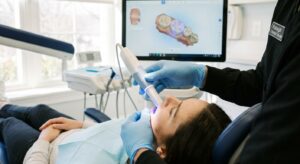
That is why View Dental Raleigh pairs every cleaning with clinical photography and diagnostic imaging. You and the dentist look at the same current picture of your teeth before any treatment comes up. The dentist’s exam also covers your existing fillings and crowns, your bite, missing teeth, and an oral cancer screening.
What Happens at Your Cleaning, From Check-In to Walking Out?
A preventive visit at View Dental Raleigh follows the same order every time: a conversation about how your teeth have been feeling, updated records, the hygienist’s evaluation and cleaning, the dentist’s exam with your images on screen, and a review of next steps before you leave. The repeatable sequence is deliberate, so nothing gets skipped from one visit to the next.
The visit opens with talking, not instruments. Your hygienist or assistant will ask whether you have noticed sensitivity, pain, bleeding, changes in how your bite fits together, or anything else you want the team to check. Your answers tell the team where to look harder. Say you mention that a lower molar twinges with ice water. Now everyone has a specific tooth to study closely on the X-ray and in the photographs, instead of hoping the problem shows up on its own.
Next, the team updates whichever diagnostic records are due. Depending on the visit, that may include digital X-rays, intraoral photographs, and digital scans. The dentist prefers current images because they let you both track change over time rather than relying on a verbal description. A filling margin that looked fine on an earlier image and now shows a dark shadow tells a different story than a single snapshot.
What the Hygienist Does During Your Cleaning
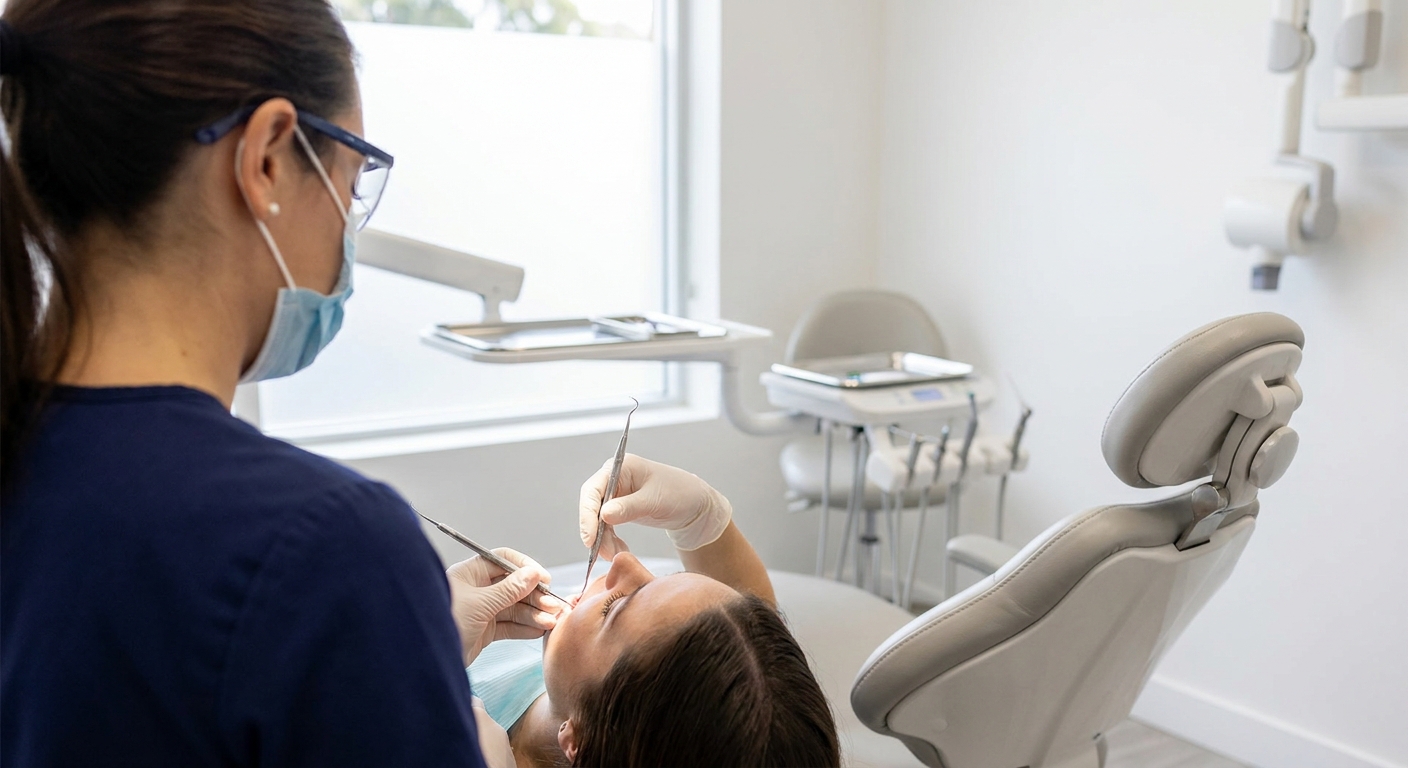
Your hygienist evaluates your teeth and gums while cleaning them, so the teeth cleaning doubles as a close inspection. As buildup comes off, the hygienist looks for:
- Areas of heavy buildup or tartar
- Inflammation and bleeding along the gums
- Gum recession
- Visible decay
- Broken or worn teeth
- Failing restorations, such as fillings or crowns that are breaking down
Anything that may need the dentist’s attention gets flagged before the doctor’s exam, so it is not left to a quick glance at the end.
How the Dentist Uses Imaging to Show You What’s Happening
Once the cleaning is done, the dentist comes in and starts with your concerns. Then they go over the clinical findings along with your X-rays, photographs, and digital scans. The exam covers each tooth, existing fillings and crowns, areas that may be fractured or decayed, missing teeth, your bite, and anything else that could affect long-term function. This is where the visit looks past the tooth that bothers you today.
The rule that matters most: you see it before you hear about treatment. If there is a crack, a cavity, or a failing restoration, the dentist points straight to it on the photograph or X-ray and explains what it means. Then the findings get sorted into three groups: what is healthy, what is simply being watched, and what should be addressed. Not every finding is presented as an emergency. If something does need treatment, you hear your options and how urgent it truly is. Seeing your own images keeps the conversation about understanding and problem solving, not selling.
Before you leave, the team reviews your preventive recommendations, fluoride or sealants when appropriate, any recommended treatment, and the timing of your next visit. Then you and the team decide together on the next step.
If the Dentist Finds Something, Do You Need a Filling Right Away?
Not always. Early decay limited to the enamel, with the tooth surface still intact, may go on a watch list with active steps to help it remineralize. Decay that has reached the dentin, broken through the surface, or kept enlarging on later X-rays usually needs a filling.
View Dental Raleigh keeps the watch-or-treat decision as objective as possible, because the dentist does not want to drill a tooth at the earliest sign of mineral loss. For early decay between the teeth, five factors guide the call:
- The bitewing X-ray
- Whether the lesion appears limited to enamel or has reached dentin
- Whether the surface has broken down (called cavitation)
- How it compares with previous imaging
- Your overall cavity risk
The goal is to step in early enough to prevent a larger problem, but not so early that healthy tooth structure gets removed when a nonrestorative option may still preserve it.
This approach matches where dental research has moved. The ADA’s evidence-based clinical practice guideline on nonrestorative treatments for caries lesions, published in the Journal of the American Dental Association in 2018, reviewed options for managing early lesions without placing a filling. Minimally invasive care rests on a simple idea: tooth structure you keep is tooth structure you never have to replace.
Curodont Repair: What “Watch” Can Actually Mean Here
At View Dental Raleigh, “watch” does not mean doing nothing. For some patients, it can include fluoride, improved home care, scheduled X-ray monitoring, and Curodont Repair.
Curodont uses a biomimetic peptide called P11-4. The peptide moves into an early cavity and self-assembles into a microscopic matrix. That matrix draws calcium and phosphate from your saliva, so new hydroxyapatite crystals, the natural mineral enamel is made of, can form inside the lesion. The process is called Guided Enamel Regeneration. It is not a coating painted on top of the tooth. It builds a scaffold within the weakened enamel that supports new mineral deeper in the lesion. Not every lesion qualifies, and the dentist will tell you whether yours is a candidate. Outcomes vary from patient to patient depending on lesion characteristics, oral environment, and individual response.
Sometimes a lesion is past that point. If decay has clearly reached the dentin, broken through the surface, kept growing on sequential X-rays, or reached a stage where remineralization is no longer predictable, the dentist is more likely to recommend a restoration, such as a tooth-colored filling. You will hear the options and how urgent each one is. The aim is to separate urgent problems from issues that may be addressed over time, so you are not pushed into everything at once.
Here is how that can look. Imagine a patient back for a cleaning after a few years away. The images show one back tooth with deeper decay, two older fillings that are starting to fail, and an early spot between two teeth with an intact surface. Rather than calling all of it urgent, the dentist points to each area on screen, explains which tooth needs attention first, which restorations may be planned for later, and which early spot may be managed with remineralization and monitoring. A finding at your cleaning is not a dead end. It is the start of a plan you help shape.
How Much Do Dental Cleanings in Raleigh Cost, With and Without Insurance?
The cost of a preventive visit depends on which images are due, whether it is your first visit, and whether your gums need a routine cleaning or a deep cleaning. View Dental Raleigh accepts Medicaid, cash pay, and Cherry financing, and the front office can give you the actual price for your visit before you book.
Visits differ for a reason. A first visit usually costs more because the team is building a full set of records. A returning visit with only routine X-rays due usually costs less. Asking “what will I owe for my visit?” is a fair question, and you deserve a real answer before you sit down.
On coverage, View Dental Raleigh accepts Medicaid. Which preventive benefits your plan covers depends on the specific plan, and the team can help you check before your appointment. NC Medicaid maintains a directory of dental providers if you want to confirm your options. For costs beyond the cleaning, such as a filling found during your dental exam, Cherry lets you pay over time.
A regular cleaning and a deep cleaning differ in both purpose and price. A routine prophylaxis is a single service for the whole mouth. Scaling and root planing is billed by area of the mouth, so the total depends on how many areas need it. It costs more than a routine cleaning and is often split across more than one visit. It is indicated when there are gum pockets of 4 millimeters or deeper along with signs like bleeding, tartar below the gumline, or bone loss on X-rays. You should see that evidence in your own measurements and images before agreeing to it.
If cost is a real barrier right now, public resources can help. The National Institute of Dental and Craniofacial Research explains ways to find dental care, and HHS lists options for finding low-cost dental care. What matters most is that you keep getting seen, because a problem caught at a cleaning is almost always simpler to manage than one found later.
Why Does It Matter Who Sees You at Every Cleaning?
Cost is one part of the decision. Who sees you is another. At View Dental Raleigh, the hygienists, assistants, and front office team make a point of getting to know you, remembering what matters to you, and noticing when something has changed. Each visit picks up where the last one left off instead of starting over with a stranger.
In a large dental service organization (DSO), care can feel more segmented simply because there are more providers, more handoffs, and more turnover. Your concerns can get lost along the way. At a private practice like View Dental, you are not shuttled from one department to the next. The same team knows your history and understands what you told them last time.
One of the clearest benefits of continuity is that it makes the watch list work. Monitoring an early lesion, or tracking whether Curodont is helping, only makes sense if someone compares this year’s X-ray with the last one and remembers why the tooth was flagged.
Because View Dental Raleigh offers comprehensive care under one roof, from cleanings and fillings to crowns, root canals, and implants, the team can think beyond today’s cleaning. If something is starting to change, the dentist can explain what to watch and how it could affect your teeth, bite, function, and future treatment needs. The treating dentist holds a DMD and has pursued extensive implant training through the International Congress of Oral Implantologists, with credentials that include Fellow status and many hands-on courses in surgical placement and restorative planning. That means the person reading your X-ray understands where a small problem may lead if it goes unmanaged. The goal is compassionate and customized care, supported by advanced technology, with a team you feel comfortable coming back to year after year.
Can You Book Just a Cleaning, and How Soon Can You Get In?
If you are a new patient or have been away from the dentist for a while, plan on a dental exam with your cleaning. The dentist needs to know which type of cleaning your gums actually need. For availability, call the office, and emergency appointments are available if you are in pain.
People ask for “just a cleaning” for understandable reasons. They want it quick, they want to keep costs down, and they do not want to be sold anything. Some also worry that after years away, someone will judge the state of their teeth. That worry is common, and it is not a reason to stay away. The team’s job is to show you what is happening and walk through your options.
Still, a cleaning without a current exam can mean getting the wrong cleaning. A routine cleaning cannot treat gum disease below the gumline. Starting without knowing whether pockets, bone loss, or decay are present means guessing. The exam is what makes the cleaning appropriate, and showing you your images before recommending anything is how View Dental Raleigh keeps that exam honest.
When people search for dental cleanings Raleigh offices can schedule soon, speed is often the top concern. Call and ask about the next available preventive appointment. If you have a toothache, tell the front office, because pain relief and emergency appointments are handled differently from routine cleanings.
Bring these to your first visit:
- A photo ID
- Your Medicaid card or dental plan card, if you have one
- Your medical history, including recent surgeries or conditions
- A list of medications and supplements you take
- Notes on anything you have noticed with your teeth or gums
Ask the front office how much time to set aside. A first preventive visit includes the conversation, updated images, the hygienist’s cleaning and evaluation, and the dentist’s exam with time for your questions, so it is usually longer than a returning visit.
Questions Raleigh Patients Ask Before Booking a Cleaning
Below are direct answers to the questions people ask most often before scheduling dental cleanings in Raleigh at View Dental.
Can I get just a cleaning without a full exam at View Dental Raleigh?
New patients and anyone who has been away from care for a while should expect a dental exam with their cleaning. The exam tells the dentist whether a routine cleaning or a deep cleaning is appropriate, and it updates the images used to track changes over time.
How much does a dental cleaning cost in Raleigh without insurance?
It depends on which X-rays and photographs are due and whether it is your first visit. Call View Dental Raleigh for the exact cash price for your visit. The office accepts Medicaid and cash pay, and Cherry financing is available for treatment beyond the cleaning.
How do I know if I need a regular cleaning or a deep cleaning?
A regular cleaning is for healthy gums or mild inflammation. A deep cleaning, called scaling and root planing, is for gum pockets of 4 millimeters or deeper with signs such as bleeding, tartar below the gumline, or bone loss. You should see the evidence before agreeing to either one.
What happens if the dentist finds a cavity during my cleaning?
The dentist shows you the X-ray or photograph first. Early decay limited to enamel with an intact surface may go on a watch list with fluoride, home care changes, Curodont Repair, and X-ray monitoring. Decay that has reached the dentin, broken through the surface, or kept growing usually needs a filling.
What is Curodont Repair?
Curodont uses a peptide called P11-4 that forms a scaffold inside an early cavity, helping new enamel mineral form from calcium and phosphate in your saliva. It is called Guided Enamel Regeneration, and it may help preserve your natural tooth when a lesion is caught early enough. Not every lesion qualifies, and individual results vary.
How long does a dental cleaning take at View Dental?
A first visit takes longer than a returning one because it includes your intake conversation, digital X-rays and photographs, the hygienist’s teeth cleaning and evaluation, and the dentist’s exam and discussion. The front office can tell you how much time to plan for.
Call View Dental Raleigh to schedule your preventive cleaning and see exactly what is happening in your mouth before anyone recommends treatment. Before you call, write down anything you have noticed in the past six months: a tooth that is sensitive to cold, gums that bleed on one side, or a bite that suddenly feels different. Bring that list to your visit. It is the first thing your hygienist will ask about, and it tells the team exactly where to look.
Schedule Your Next Cleaning With Confidence
Now that you know exactly what to expect during your dental cleaning, there’s no reason to put off that appointment. Our team at View Dental Raleigh takes the time to walk you through each step and answer your questions, so you can feel completely at ease in the chair. If it’s been a while since your last visit or you’re simply ready to keep your smile healthy, we’re here to help.
Individual clinical outcomes vary depending on tooth condition, oral hygiene, lesion characteristics, and patient response.