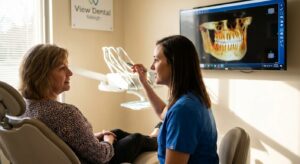

Roughly 36% of Americans experience dental anxiety significant enough to delay or avoid care, according to a 2019 study published in the Journal of Dental Research examining over 15,000 adults across the United States. The longer the avoidance stretches, the more complex the problems become, which then feeds the fear further. These seven dental anxiety tips are drawn from clinical research, not generic reassurances, and each one gives you a concrete action you can take before or during your next visit in Raleigh.
1. Tell Your Dentist Exactly What Scares You Before the Appointment Starts
A 2021 study published in Patient Education and Counseling, involving 1,340 adult dental patients, found that structured pre-appointment disclosure of specific fears reduced both self-reported anxiety scores and physiological markers like heart rate during treatment. The mechanism is straightforward: naming your fear out loud shifts you from passive patient to active participant, and that shift changes what your nervous system does with the threat signal.
Vague statements like “I’m nervous about dentists” do not carry the same weight as specific ones. “I had a painful extraction ten years ago and I’m afraid of needles” gives the clinician something to work with. A practice that takes patient anxiety seriously will document what you share and adjust the appointment structure accordingly, sometimes reordering steps, offering additional numbing time, or simply slowing down.
The action: before your next appointment, write down your top one or two specific fears on your phone. Read them to the front desk the moment you arrive. If you feel embarrassed, know that anxious patients make up a significant portion of any dental practice’s schedule. The fear is far more common than it seems from the outside.
2. Establish a Stop Signal Before the Drill Turns On
A 2018 study in the Journal of Anxiety Disorders, following 620 adult patients with moderate to high dental anxiety, found that perceived control over the procedure was the single strongest predictor of reduced anxiety during treatment, stronger than distraction or music. When the brain knows it can stop something, it reclassifies the situation from threat to manageable. That reclassification is not semantic. It changes cortisol levels, muscle tension, and pain perception in measurable ways.
The stop signal itself is simple: raise your left hand, and the dentist stops. No questions, no pressure to continue. Agreeing on this before the procedure starts, not during it, is what makes it work. The agreement needs to happen when you are calm and verbal, so that when you are supine with instruments in your mouth, the signal is already loaded and ready.
Some patients who struggle with the moment the procedure begins find that just knowing the signal exists is enough to prevent them from needing it. The relief comes from the option, not just the use of it.
3. Use Controlled Breathing to Interrupt the Anxiety Reflex
A 2017 randomized controlled trial published in Frontiers in Psychology, studying 96 patients scheduled for invasive dental procedures, found that diaphragmatic breathing practiced before and during the appointment reduced anxiety scores by 38% compared to a control group receiving standard care. The physiology is direct: slow, deep breathing activates the parasympathetic nervous system, which counteracts the fight-or-flight response the dental chair tends to trigger.
The specific technique with the strongest evidence base for acute anxiety is box breathing: inhale for four counts, hold for four counts, exhale for four counts, hold for four counts. Repeat four cycles. Four-seven-eight breathing (inhale for four, hold for seven, exhale for eight) works for some people even faster, particularly when exhaling slowly is the main focus.
The action that matters most: practice this once today, away from any dental context. Sitting at your desk or before bed is fine. Practicing outside the office means the pattern is automatic when your body needs it, rather than something you’re trying to learn while already activated.
4. Book the First Appointment of the Day
A 2020 survey conducted by the American Dental Association across 8,400 adult patients found that anticipatory anxiety, the dread that accumulates in the hours before an appointment, was rated as more distressing than the procedure itself by 54% of respondents who reported moderate to severe dental fear. Anticipatory anxiety needs time to build. A morning appointment eliminates most of that window.
Beyond the psychological benefit, the practical advantages of an early slot are real. The dentist is not running behind from a complicated case earlier in the day. The waiting room is quieter. The office itself has not yet accumulated the ambient sounds and activity that can heighten sensory sensitivity in anxious patients.
When scheduling at a Raleigh dental office, ask specifically for the first available morning slot and explain that you have dental anxiety. Most offices will note this in your file and prioritize early scheduling for future appointments as well.
5. Use Distraction Strategically, Not Passively
A 2019 study in the International Journal of Paediatric Dentistry, with 284 participants ranging from adolescents to adults, compared passive distraction (background music through office speakers) with active distraction (patient-chosen audiobooks or podcasts through personal earbuds). Active distraction reduced procedural anxiety by 31% more than passive distraction. The reason is cognitive load: active distraction competes for the same mental bandwidth that anxiety signals use. Background music does not compete effectively enough.
The distinction is the difference between music you notice occasionally and a podcast episode you are genuinely tracking. If you are following a story or an argument, your brain has less capacity to catastrophize. Choosing something engaging before you leave the house is what makes this work. A thriller episode, a documentary series, a conversation-style podcast with a host you like, all of these work better than a calming playlist.
The one action: load a specific episode on your phone before you walk out the door. Not while you are sitting in the waiting room, not when the chair reclines. Before you leave.
6. Ask About Nitrous Oxide or Sedation Options Before You Decide You Don’t Need Them
A 2020 Cochrane Review analyzing 17 randomized controlled trials covering 1,731 patients found that nitrous oxide (inhaled anxiolysis) significantly reduced self-reported anxiety and improved patient cooperation during dental procedures, with an acceptable safety profile and rapid offset. Nitrous oxide keeps you fully conscious and aware. You can still communicate with the dentist, respond to instructions, and make decisions. It wears off within minutes of removing the mask, meaning you can drive yourself home afterward.
The spectrum of options goes further than nitrous alone. Oral anxiolytic tablets, typically a short-acting benzodiazepine taken about an hour before the appointment, reduce baseline anxiety before you arrive. Conscious sedation provides deeper relaxation while keeping you responsive. Each option serves a different level of anxiety, and none of them are reserved exclusively for patients with severe phobias. If dental anxiety has caused you to delay or cancel appointments, any of these options is medically appropriate.
The action: on your next call to a Raleigh dental office, ask directly whether nitrous oxide is available. Frame it as a routine question, because it is one. Asking does not commit you to anything. It opens the conversation.
7. Rebuild Trust Gradually With Low-Stakes Visits First
A 2016 study in the Journal of Consulting and Clinical Psychology, involving 215 adults with clinically diagnosed dental phobia who underwent a structured systematic desensitization protocol, found that 77% completed previously avoided dental procedures within six months of beginning graduated exposure, compared to 28% in the waitlist control group. The mechanism is well-established: the brain unlearns fear through repeated safe exposures, each one slightly more involved than the last, until the feared context stops registering as dangerous.
For someone who has avoided the dentist for years, walking into an office expecting to complete a full treatment plan in one visit sets up an almost guaranteed failure. A low-stakes first visit, a cleaning, a consultation, or even just a tour of the office with no procedure scheduled, gives the nervous system evidence that the environment is safe without demanding that it handle more than it currently can.
Patients who’ve delayed care for a year or more benefit most from this approach, and finding a practice that accommodates this kind of graduated schedule is worth asking about directly. Tell the scheduler it’s a first step, not a full appointment. A practice that works regularly with anxious patients will know exactly what that means and how to structure it.
What to Try Before Your Next Appointment
Do not try all seven at once. Pick the one that removes the biggest barrier between you and making the call.
For most people in Raleigh who’ve been putting off care, the lowest-barrier move is this: call a dental office, name your anxiety out loud, and ask for the first morning slot available. That single action starts the process. You do not have to commit to treatment. You do not have to have all your questions answered on the phone. You just have to make the call and say, “I have dental anxiety and I haven’t been in a while. I want to take a first step.”
The fear does not disappear before the appointment. It decreases through the appointments, once your nervous system has evidence that the experience is manageable. The first step is the one that counts.
Frequently Asked Questions
How do I tell my dentist I have anxiety without feeling embarrassed?
Say it directly at the start: “I have dental anxiety and I want you to know before we begin.” Dental teams hear this regularly. Naming it is not a sign of weakness; it is information that changes how the appointment runs. Practices that work with anxious patients are prepared for this conversation and will not react with surprise or judgment.
Is it normal to feel anxious about the dentist even as an adult?
Yes. Research consistently shows that dental anxiety affects adults across all age groups, education levels, and backgrounds. It is not a childhood habit that people simply outgrow. Many adults with significant dental anxiety trace it to a single negative experience years earlier, which is a normal fear-conditioning response, not a character flaw.
What if I’ve avoided the dentist for so long that I’m ashamed of my teeth?
Shame about the condition of your teeth is one of the most common reasons people continue avoiding care. Most dental professionals who see high volumes of anxious patients are not in the business of judgment; they are in the business of figuring out where you are now and what you can do from here. The longer you wait because of shame, the more complex the situation becomes. A first visit focused only on an exam, with no treatment pressure, is a reasonable way to start without the stakes feeling overwhelming.
Does nitrous oxide actually work for dental anxiety, or is it just for severe phobics?
It works, and it is not reserved for severe phobias. The 2020 Cochrane Review on nitrous oxide found significant anxiety reduction across patients with mild to moderate anxiety, not only those with clinical phobia. If anxiety has caused you to delay or cancel appointments at any point, asking about nitrous oxide is appropriate and worth the conversation.
What is the fastest thing I can do right now to feel more in control of my dental anxiety?
Agree on a stop signal with your dentist before any procedure starts. This single step changes the nervous system’s read of the situation from “trapped” to “in control,” which reduces perceived pain and anxiety measurably. It takes thirty seconds to establish and costs nothing.
How long does it typically take for dental anxiety to improve with a new practice?
Most patients notice a meaningful shift within the first two to three appointments, assuming those visits go smoothly and the practice is genuinely oriented toward patient comfort. The brain updates threat assessments based on recent evidence. Two or three low-pressure experiences are usually enough to change the baseline, though the full shift for patients with long histories of avoidance can take slightly longer.