Expertise provided by Calvin Chen, Owner
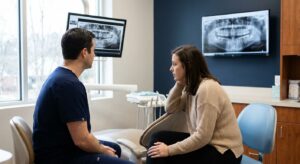
If you have been told you need an implant but all you have seen is a surgery date and a number, you are right to want the whole path before you say yes. Many offices offer dental implants in Raleigh. What patients often miss is everything between the first visit and the bill: why the implant goes where it goes, whether it may be possible to place it the day the tooth comes out, what happens if your bone is thin, and what the finished tooth costs once every step is added up. At View Dental Raleigh, that explanation is part of the plan, and you see it before you commit to anything.
You may also have a quieter worry. You might feel embarrassed about how long you have waited, or you might expect to be pushed toward the most expensive option. Those concerns are reasonable. View Dental Raleigh does not assume every patient has the same priorities, and it does not treat the most aggressive treatment as automatically the best one. It also does not criticize work another dentist has done. The starting point is simpler: understand what you ultimately want to accomplish, then build the clinical path toward that goal.
What Are Dental Implants, and Why Does Planning Start With the Final Tooth?
A dental implant is a replacement tooth root. It is a small post placed in the jawbone that supports a connector, called an abutment, and a crown on top. At View Dental Raleigh, planning starts with that crown, the part you see and chew with, and works backward to where the post belongs.
The StatPearls review of dental implants from the NIH describes these three parts and the way bone bonds to the implant over time. That bond, called osseointegration, allows the implant to act like a root. Once it heals, the implant carries chewing forces into the jaw in a way that resembles a natural tooth. Because of this, where the implant sits matters as much as whether it heals.
Think of building a house. A careful builder does not pour a foundation in whatever spot is easiest and then hope the house fits. The builder starts with the blueprint and pours the foundation to support the finished house. Implant planning at View Dental Raleigh follows the same logic. The dentist first looks at how the final tooth should look, how it should function, and where it needs to sit in your bite and smile. Only then does the plan move to the bone underneath. The question is not “Where can we fit an implant?” It is “Where should this implant go to support the tooth or prosthesis we are working toward?”
That difference can show up later in daily life. An implant placed only where bone happens to be available can leave the crown angled oddly, hard to clean, or out of line with your bite. A plan built from the final tooth aims for a crown with good contacts against its neighbors, margins that are easier to keep clean, and a bite that is comfortable.
Planning from the end result also means looking beyond the tooth that hurts today. A common problem is dental work done one tooth at a time with no plan for the rest of the mouth. Each filling or crown may be fine on its own, while infection, gum disease, missing teeth, or bite problems continue to create new concerns. Sometimes the right answer is to keep a natural tooth rather than replace it. The American Association of Endodontists publishes treatment-planning resources on weighing a natural tooth against an implant for this reason. When a tooth may be saved, that option belongs in the conversation.
This is also why View Dental Raleigh treats placing an implant and restoring it as two halves of the same job. The surgical plan and the final tooth are designed together from the start, rather than handed from one step to the next.
What Is Involved in Getting Dental Implants in Raleigh, NC?
Getting dental implants in Raleigh at View Dental Raleigh follows a clear sequence. It starts with an exam and a complimentary CBCT 3D scan, moves through a combined surgical and restorative plan, and ends with your final tooth once the implant has healed. Every step is explained before it happens.
The typical sequence looks like this:
- A comprehensive exam and bite evaluation, starting with your goals and concerns
- Digital X-rays and a complimentary CBCT 3D scan of your jaw
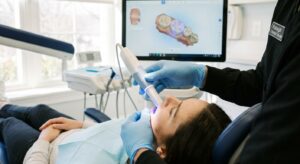
- A 3D intraoral scan of your teeth and bite, in place of traditional impressions
- A plan that combines the surgical and restorative sides of the case
- A decision between immediate and staged placement, with bone grafting when needed
- Implant placement, using a digitally planned surgical guide when it may improve accuracy
- Healing and monitoring
- The final crown, bridge, or snap-in denture once the implant is ready
View Dental Raleigh works primarily with one implant system. Using a familiar system lets the planning, the surgical parts, and the restorative parts fit together the same way from case to case.
Healing usually takes months, not weeks. The bone needs time to bond to the implant before it takes full chewing force, and grafted sites need extra time before the implant goes in. The exact timeline depends on your bone, your health, and whether grafting is part of the plan. That is why the practice maps your phases after the 3D scan instead of quoting a schedule beforehand.
Maintenance does not stop when the crown goes on. An implant cannot get a cavity, but the gum and bone around it can become inflamed. The NIH StatPearls review describes this as peri-implantitis, an inflammation of the tissue around an implant that is linked with plaque buildup and can lead to bone loss. In practice, that means daily brushing and cleaning around the implant, plus regular checkups where the tissue and bone are monitored.
Do You Need a CBCT Scan, and When Is a Surgical Guide Used?
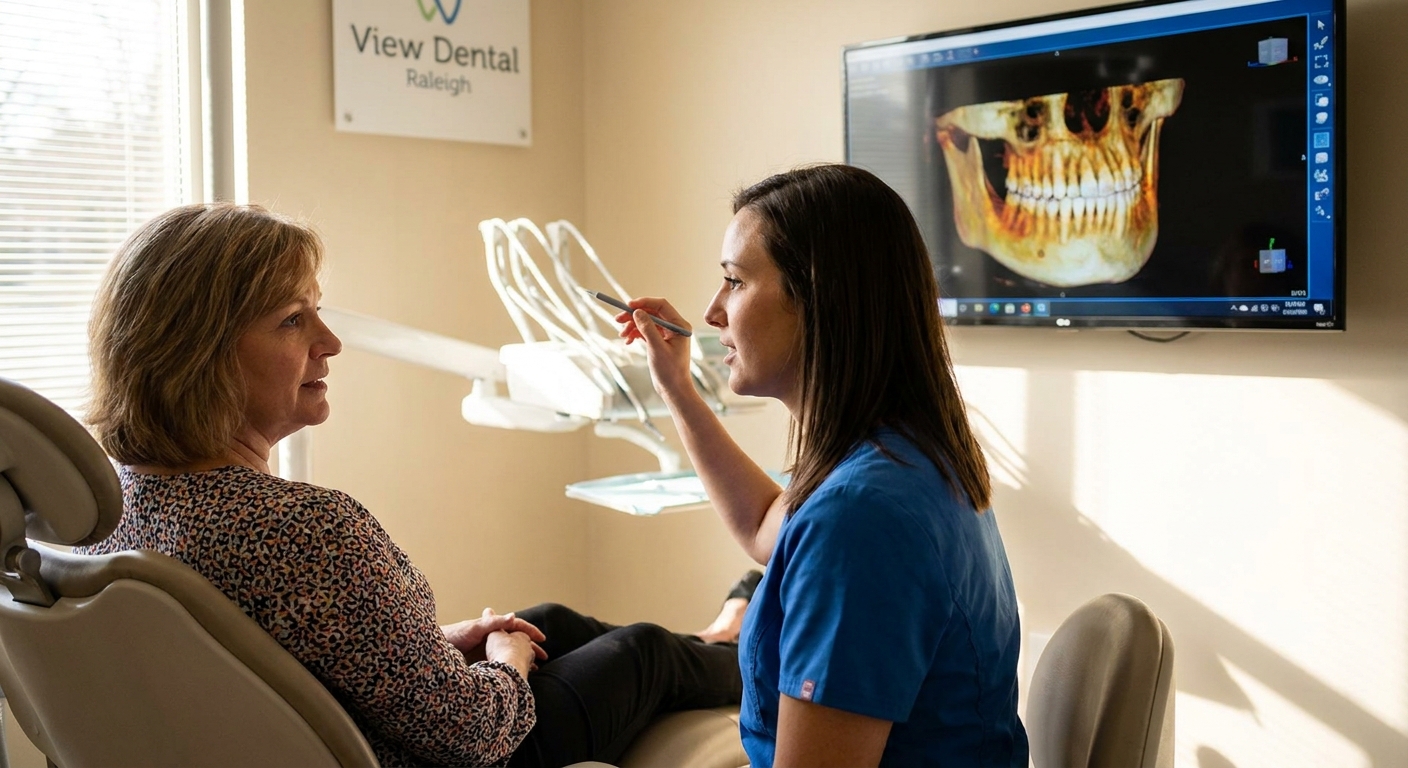
For implant planning, a CBCT scan is part of the process at View Dental Raleigh, and it is complimentary. It helps show whether your bone may be able to support the tooth you want. A regular X-ray shows a flat picture, while a CBCT shows the jaw in three dimensions, so the dentist can measure what a flat image cannot.
With that scan, the dentist compares the ideal tooth position against your real anatomy:
- Bone height and width at the site
- The shape of the ridge and of any extraction socket
- The thickness and health of the gum tissue
- The location of the sinus in the upper jaw
- The path of nerves in the lower jaw
The CBCT is then combined with your 3D intraoral scan. One shows the bone, and the other shows your teeth, gums, and bite. Together they let the surgical plan and the restorative plan be built at the same time. This is where digital technology can be useful: not on display for its own sake, but helping the implant position support the final tooth.
A digitally planned surgical guide is a custom template that helps transfer the planned implant position into your mouth during surgery. View Dental Raleigh uses one when it may improve accuracy, such as when anatomy is limited, when more than one implant is planned, or when the position needs to follow the planned crown closely. Not every implant needs a guide, so the approach is chosen for your case rather than used the same way on everyone.
Immediate or Staged Placement: How Is the Decision Made?
Once the scans are reviewed, one of the biggest questions is timing. Placing an implant the same day a tooth is removed is a judgment call, not a promise. View Dental Raleigh considers it only when the bone, gum tissue, infection status, and implant stability all line up. When they do not, the site is grafted and allowed to heal first.
The decision does not rest on one number. Before the tooth comes out, the dentist uses the clinical exam and CBCT to check the surrounding bone, any infection, the gum tissue, and whether the implant may be able to anchor firmly in bone beyond the extraction socket. Immediate placement is considered only when the tooth can be removed carefully, the remaining bone appears favorable, and the implant can sit in the correct 3D position with good stability from the start.
During surgery, there is also an objective measurement. Insertion torque tells the dentist how firmly the implant grips the bone as it goes in, measured in newton centimeters (Ncm). At about 35 Ncm or more, combined with favorable bone, implant position, gum tissue, and bite, an immediate restoration may be appropriate. If the implant does not reach the stability the dentist wants, the team does not force an immediate tooth just to shorten treatment. Instead, the implant gets more healing time before it goes into function.
When the site is not ready, a staged approach may be recommended. This can happen because of significant bone loss, active infection, unfavorable anatomy, or a site that would simply be better suited to implant placement after healing. The tooth comes out, the site is grafted, and the implant is placed after the graft heals. Bone grafting is offered in-house at View Dental Raleigh.
In plain terms, a bone graft adds bone-building material to an area that lacks enough height or width to hold an implant. Your body gradually uses that material as a framework to rebuild bone. Picture a fence post: if the ground around the hole is soft or too narrow, you firm it up before setting the post, or the post wobbles. A graft serves a similar purpose for an implant.
Staged placement takes longer, and that is a real tradeoff. If you are weighing it, you are trading time now for a more suitable foundation later. The goal is not to make every implant an immediate case. The goal is to give each implant a healing environment that suits your situation and supports the final restoration.
What Does View Dental Raleigh Handle In-House, and What Is Referred Out?
View Dental Raleigh places and restores single-tooth implants, implant-supported bridges, and snap-in dentures in its Raleigh office, and offers bone grafting there too. Full-arch cases are not offered at the practice and are referred to an oral surgeon partner.
It helps to know this before your first visit. If you need one tooth replaced, a short span of missing teeth replaced with an implant-supported bridge, or a loose denture stabilized with implants, the same office handles the planning, the surgery, and the final restoration. Snap-in dentures click onto implants so the denture can stay in place while you eat and talk. If your case needs a full arch of fixed teeth on implants, View Dental Raleigh will tell you so up front and refer you to its oral surgeon partner.
For the cases handled in-house, one office means fewer handoffs. In a split arrangement, one provider places the implant and another builds the crown, so you travel between offices and your records travel too. When the person planning the final tooth also plans and places the implant, the surgical and restorative goals start out aligned. That is what comprehensive care under one roof means here: a single coordinated roadmap rather than a chain of disconnected appointments.
If you feel anxious about surgery, say so during planning. Every step is explained before it happens, and your questions are answered before anything is scheduled.
An implant is also one phase of care, not an all-or-nothing decision. One patient arrived with infected and broken teeth, missing back teeth, a limited budget, and a firm wedding date. Implants were the clinically ideal long-term plan, but they were not financially realistic for her at that stage. The team separated the ideal destination from the most appropriate immediate path. First, the teeth that could not be saved were removed. Next, the salvageable teeth were restored. The visible gaps were then filled with an aesthetic flexible partial denture, after the team explained its benefits, limitations, maintenance, and removable nature compared with implants. She also left with a clear future implant plan, so the partial was a step forward and not a dead end. Her case is shared on the View Dental Raleigh Instagram, along with other cases from the office. This is one person’s experience, not a typical result.
The takeaway is simple. View Dental Raleigh recommends implants based on clinical merit and on how well they fit your budget and timeline. The practice is not simply trying to fix one problem and move on.
How Much Do Dental Implants Cost in Raleigh, and What Are Your Payment Options?
The cost of a dental implant is a total, not a single line item, and View Dental Raleigh does not quote a meaningful price until your exam and 3D imaging are done. Once they are, you see the full total first and the monthly options second.
Depending on your case, a single implant’s total can include:
- The implant itself
- The abutment that connects it to the tooth
- The final crown
- Removal of the failing tooth, if it is still present
- Bone grafting, if the site needs it
Two people can both “need an implant” and have very different totals. One may need only the implant, abutment, and crown, while another may need an extraction and a graft first. That is why a price quoted before imaging tells you little. A low advertised monthly payment can also hide a large total, so View Dental Raleigh shows the total treatment investment before any monthly figure.
An implant is also not the only way to replace a missing tooth. Comparing options fairly means looking at benefits, limitations, expected maintenance, timing, and cost together:
| Option | What it involves | Effect on nearby teeth | Ongoing care |
|---|---|---|---|
| Single implant | Post, abutment, and crown, with surgery and healing time | Stands on its own without relying on neighbors | Daily cleaning around it and regular checkups to monitor for peri-implantitis |
| Bridge | A false tooth held by crowns on the teeth on either side | The neighboring teeth are reshaped to hold crowns | Cleaning under the bridge every day |
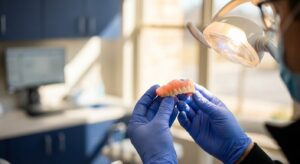
| Flexible partial denture | A removable appliance that fills gaps | Rests against your existing teeth | Taken out for cleaning, with adjustments over time |
Each has a place. A bridge can make sense when the neighboring teeth already need crowns. A flexible partial can be a reasonable first step when budget or timing comes first, with an implant kept as the later goal. Think of the table as a starting point for the conversation, not a verdict.
Cherry lets qualified patients spread treatment over monthly payments, and it is a payment method, not insurance. Approval and terms depend on the plan you qualify for. View Dental Raleigh also accepts Medicaid. Do not assume it covers implants, though. Ask the team to review your specific plan before you build your budget around it.
Questions Raleigh Patients Ask Before Committing to an Implant
These are practical questions worth asking before you commit to any implant plan. Here is how View Dental Raleigh handles each one.
How long do dental implants take from start to finish?
It depends on whether you need an extraction, grafting, or extra healing time. Bone needs months to bond to an implant, and grafted sites need to heal before placement, as the NIH StatPearls review describes. View Dental Raleigh maps your phases after the 3D scan, so you see a sequence based on your case rather than a guess.
Do I need a bone graft before getting a dental implant?
Only if the bone at the site lacks enough height or width to hold the implant firmly in the right position. The CBCT scan helps show this before any surgery is scheduled. If grafting is needed, View Dental Raleigh offers it in-house. In a staged plan, the tooth is removed and the site is grafted first, and the implant is placed after the site heals.
Can I get a tooth the same day my tooth is removed?
Sometimes. It requires careful removal, favorable bone, healthy gum tissue, no infection that complicates placement, and strong stability measured at surgery, around 35 Ncm or more of insertion torque. If stability falls short, View Dental Raleigh does not force an immediate tooth. The implant heals first, and the crown follows.
Are dental implants better than a bridge or partial denture?
Not necessarily. Implants do not rely on neighboring teeth, but they involve surgery, healing time, and a higher upfront total. A bridge or flexible partial denture can fit a tighter budget or timeline. At View Dental Raleigh, an alternative can be a planned first step, with an implant kept as the later goal.
Does View Dental Raleigh handle every type of implant case?
No. View Dental Raleigh places and restores single-tooth implants, implant-supported bridges, and snap-in dentures in its Raleigh office, along with bone grafting. Full-arch cases are referred to an oral surgeon partner. If your case falls outside what the office handles, you will hear that plainly at your consultation.
How do I care for an implant after it is placed?
Brush and clean around the implant every day, and keep regular checkups so the gum and bone around it can be monitored. The main long-term concern is peri-implantitis, an inflammation linked with plaque buildup that can lead to bone loss.
See the Whole Path, and the Total, Before You Say Yes
The next step is a consultation at View Dental Raleigh in Raleigh, NC. It includes your complimentary CBCT scan and a full plan with the total cost for dental implants in Raleigh, all before you commit to anything. Your care will be compassionate and tailored to your bite, your budget, and your timeline.
Before you come in, decide what matters most to you right now. It might be comfort when you chew, the look of your smile, saving as many teeth as possible, or keeping the cost manageable this year. Your answer shapes the sequence. Knowing it before you sit down helps the dentist separate urgent problems from issues that can be addressed over time, so your plan starts where you actually are.
Last updated November 2026
Ready to Talk Through Your Dental Implant Options in Raleigh?
If you have been wondering whether implants are right for you, or putting off the question because the process feels like a lot, a conversation is a simple place to begin. The team at View Dental Raleigh can walk you through how planning, placement, and restoration fit together so you know what to expect before anything starts. Give the office a call and take the first step toward a smile you feel confident about in Raleigh, NC.
Individual results vary.