Invisalign in Raleigh: What Clear Aligner Treatment Actually Involves and How to Know If Your Case Is Appropriate
You type “Invisalign near me” into Google, call a few Raleigh offices, and every single one says “Yes, we do Invisalign.” Then you ask what cases they actually take on versus refer, or how they decide whether your bite is healthy enough to treat with aligners, and the answers get vague. That vagueness matters. If you are researching Invisalign in Raleigh, the dentist’s judgment about which cases to take on is just as important as the aligners themselves, because not every alignment problem is appropriate for clear aligner treatment, and some cases may be better suited to other approaches.
At View Dental Raleigh, we do not assume every patient has the same priorities, and we do not assume every set of crowded teeth belongs in aligners. This page walks you through what clear aligner treatment actually involves, which bite problems may be addressed with it, and how we decide, step by step, whether your case is one we might treat here or one that would be better managed another way.
What Clear Aligner Treatment Is, and Where Invisalign Actually Fits
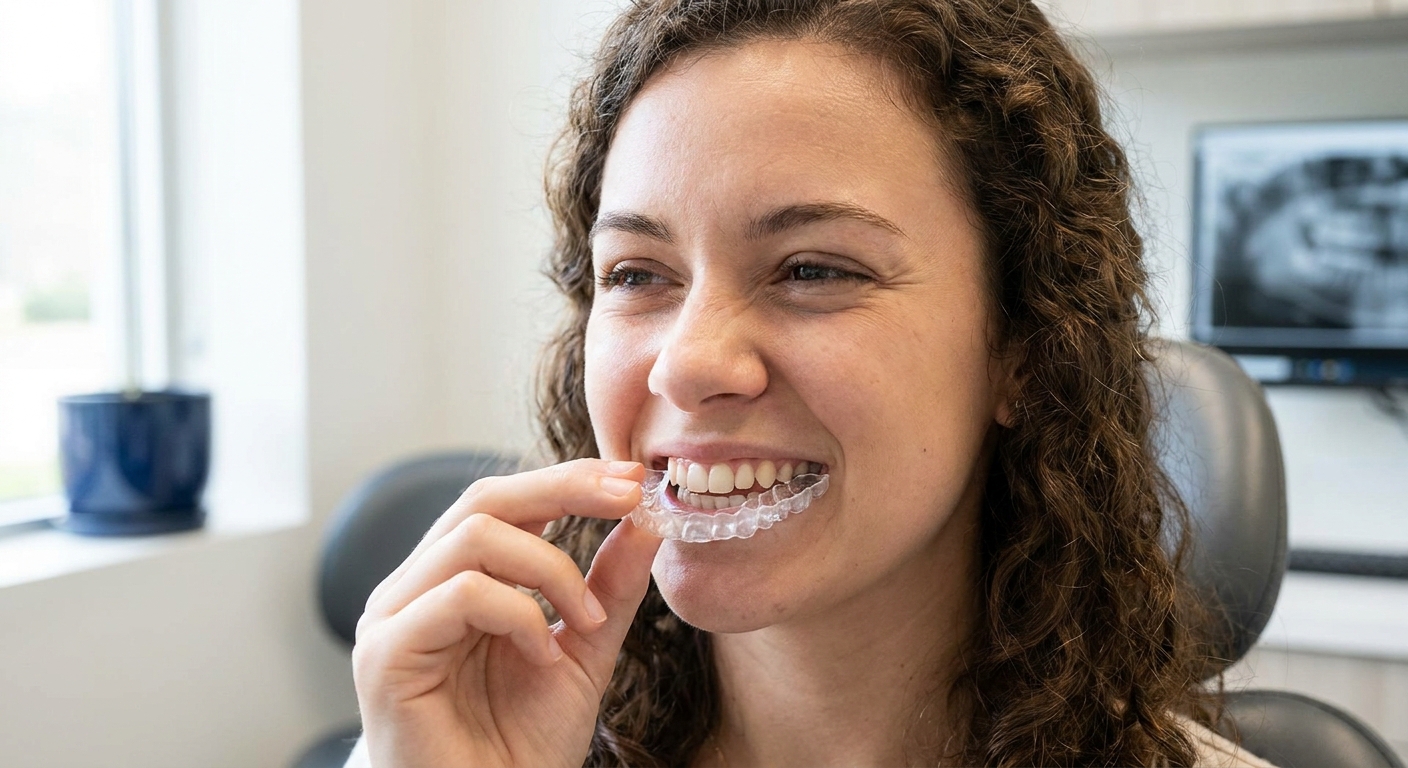
Invisalign is a brand name, not the name of the treatment. Clear aligner therapy is the broader category: a series of removable, clear plastic trays that move your teeth in small, planned steps toward a new position. Invisalign is one company that makes those trays, and there are several others.
At View Dental Raleigh, we use CandidPro rather than Invisalign, so the workflow behind your treatment is different even though the trays look similar in your mouth. First, we evaluate your bite, your alignment, the health of your teeth and gums, and what you actually want to change. We then capture a digital 3D scan of your teeth instead of the older physical impression trays, along with X rays and clinical photographs. Where Invisalign runs its planning through its own scanning and preview software, CandidPro provides its own digital treatment planning system.
The part that sets this system apart is the collaboration model. Your plan is developed with a United States licensed orthodontist, and it comes back to your dentist for review and approval before any trays are manufactured. We also use remote progress monitoring, which lets you take short at-home progress scans between visits so we can track how your teeth are responding without asking you to come in every few weeks. The technology is comparable to what you have read about with Invisalign, and the difference is who reviews the plan and how closely your case is checked before it starts.
Which Bite Problems Clear Aligners May Address, and Which Cases May Need Different Treatment Approaches
Clear aligners can work for some mild to moderate alignment concerns, and they are not typically the right tool for significant skeletal issues. The dividing line is often whether the problem is mostly about tooth position or mostly about how your jaws relate to each other.
CandidPro’s case-selection guidelines give us useful benchmarks. For more straightforward Class I cases, we are generally looking at crowding or spacing of about 6 mm or less, overbite or overjet of about 4 mm or less, midline correction, intrusion, or extrusion of about 2 mm or less, and tooth rotations that fall roughly within 20 to 40 degrees. Crowding and spacing tend to be among the more predictable movements in appropriate cases. Teeth that are tipped inward can sometimes be moved outward and aligned, and some deep bites may improve as we level the arches. Certain dental anterior crossbites, where the issue is tooth position rather than the underlying jaw, may also be addressable.
Then there is a middle category. A molar crossbite, a moderate open bite, significant expansion, or a more involved Class II bite may still be potentially treatable with aligners in some patients, but those cases require more careful planning, sometimes attachments or small amounts of space created between teeth, and a much closer look at the proposed plan before we commit.
The line becomes clearer when the problem is primarily a jaw relationship. If your upper and lower jaws have a significant front-to-back mismatch, if there is a major skeletal bite problem, a significant Class III relationship, or a case that may require jaw surgery, we would rather refer you than attempt that case with trays. CandidPro itself recommends orthodontic referral when significant front-to-back correction between the arches is needed. Sometimes the most useful thing we can tell you is that your teeth may be improved, but an orthodontist is the better person to manage this particular movement. That is not a dead end. It is us pointing you toward what may be the most appropriate path for your situation.
How Invisalign in Raleigh Gets Planned at View Dental Raleigh, From Scan to Final Approval
Your plan is built in stages, reviewed by both a dentist and an orthodontist, and shown to you before you commit to anything. We want you to see and understand what we are evaluating rather than simply being told you need treatment.
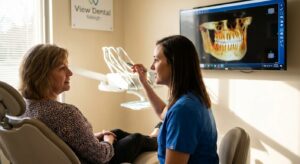
First, we take professional full-face and smile photographs in our dedicated photo studio. These let us evaluate your smile as part of your whole face, not just whether individual teeth are straight. We look at how much tooth you show when you smile, your smile symmetry, and how your teeth relate to your lips. We then use a digital intraoral scanner to build a detailed 3D model of your teeth and bite, which we can rotate on the screen so you can see your own crowding, spacing, and how your upper and lower teeth actually meet. We can also use that digital information to create a simulation of how your teeth may look after alignment. This simulation is for general planning purposes only, and individual responses to treatment vary.
Next, we submit your scan, photographs, X rays, and treatment goals, and the case is developed with a United States licensed CandidPro orthodontist. Before any trays are made, that plan comes back to Dr. Chen for review. He moves through a 3D treatment-plan viewer step by step to see how your teeth are projected to move from start to finish. He is checking more than whether the front teeth look straighter. He reviews the proposed final tooth positions, how the upper and lower teeth come together, whether the planned movements make sense for your bite, and the overall sequence. He also reviews the clinical details built into the plan, including planned interproximal reduction (small amounts of space created between certain teeth), attachments, tooth spacing, and bite ramps, along with the timing of each of those steps.
We also keep the option to push back. If Dr. Chen does not like something about the setup, he does not have to approve it. He can send it back to the CandidPro clinical team and orthodontist with specific revision requests, or he can schedule a video consultation with the orthodontist to talk through a more complicated case. Only once he is comfortable does the plan move into production. That judgment stage is the difference between thoughtful care and assembly-line aligner sales, and it is where existing crowns, fillings, or missing teeth get worked into the plan instead of being ignored.
Why a Dentist’s Training and Judgment Matter as Much as the Aligners
The aligners are the same plastic no matter who orders them. What influences your experience is the person deciding whether your case may be appropriate for aligners, and whether the proposed plan is sound for your bite. Dr. Calvin Chen, DMD, has completed extensive continuing education in clear aligner therapy, including training focused on case selection, treatment planning, tooth movement, bite evaluation, and monitoring patients through treatment.
He also does not plan these cases alone. With CandidPro, planning is supported by United States licensed orthodontists who review comprehensive treatment plans before they come back for approval, and CandidPro provides ongoing orthodontist consultation when a case needs more guidance during treatment. The company also offers additional clear-aligner education covering case selection, treatment planning, clinical techniques, and monitoring.
Here is the part that matters most for you. Continuing education gives a dentist the clinical foundation, but good judgment is just as important. Dr. Chen would rather refer a case that may require more specialized orthodontic management than attempt aligners in a situation where they may not be the most appropriate option. In dentistry, knowing where the boundary sits is a sign of expertise, not a limitation. For cases he considers appropriate, he stays the treating dentist responsible for evaluating your oral health, reviewing and approving the plan, and monitoring your progress. That combination of continued education, careful case selection, doctor oversight, and orthodontist-supported planning is how we approach clear aligner treatment here.
What Clear Aligner Treatment Costs in Raleigh, and How to Have an Honest Pricing Conversation First
The investment for clear aligner treatment varies considerably based on what your teeth actually need. In our practice, we have seen patients with mild front crowding complete treatment in eight to ten months with relatively few trays, while patients with more spacing, rotations, or bite adjustments may need eighteen months or more, which means more aligners, more monitoring, and sometimes refinement trays to finish the case properly.
Understanding what moves the number is as important as the number itself. A case with mild crowding and a good jaw relationship sits at the lower end, while a case that needs more movements, attachments, interproximal reduction, or a second round of refinement trays sits higher. Treatment length matters too, because more steps mean more trays and more monitoring. We would rather show you where your specific case falls and why than quote you a headline price that changes later.
We also want the money conversation to be as clear as the clinical one. We accept Medicaid and cash pay, and we work with Cherry for patients who want to spread payments out over time rather than pay all at once. Before you commit, we walk you through what your plan includes, what it does not, and whether any dental concerns, such as cavities, gum disease, worn teeth, or missing teeth, need to be addressed or built into the plan first. Understanding the entire picture before you commit is the point, and you should never feel pushed toward treatment you do not understand.
Questions Raleigh Patients Ask About Clear Aligners
Is Invisalign the only clear aligner option in Raleigh?
No. Invisalign is one brand of clear aligner. View Dental Raleigh uses CandidPro, which offers comparable clear aligner technology with a different planning workflow and an orthodontist-collaboration model, so your plan is reviewed by a licensed orthodontist before your trays are made.
How do I know if my teeth might be addressed with aligners or if I need traditional braces?
Dr. Chen evaluates your bite, the amount of crowding or spacing, any rotations, and your jaw relationship during a consultation. Some mild to moderate cases may be appropriate for aligners, while significant skeletal problems, such as a large jaw mismatch, typically call for comprehensive orthodontic treatment instead.
What happens if the treatment plan does not look right to the dentist?
Dr. Chen reviews every CandidPro treatment simulation before he approves it. If he sees a concern with the planned tooth movement, the bite relationships, or the proposed final positioning, he can request specific revisions or schedule a video consultation with the orthodontist before any trays are manufactured.
How much does clear aligner treatment cost in Raleigh?
Your cost depends on how many trays your case requires, how long treatment runs, and whether refinements are needed to finish properly. We give you a specific estimate after we review your scan and can show you exactly what movements are planned and how those influence the total investment.
Does Dr. Chen treat every case, or does he refer some to orthodontists?
He refers cases involving significant jaw discrepancies, skeletal bite problems, significant Class III relationships, or situations where comprehensive orthodontic treatment may be more appropriate. He takes on cases that he considers suitable for aligner therapy and refers the ones that may benefit from specialized orthodontic care.
How does View Dental Raleigh monitor my progress during treatment?
The practice uses remote at-home progress scans between office visits. That lets Dr. Chen track how your teeth are responding and address concerns early without asking you to come in every few weeks.
If you have been comparing options for Invisalign in Raleigh, schedule a clear aligner consultation at View Dental Raleigh so Dr. Chen can evaluate your bite, review your 3D scan with you on the screen, discuss whether your case may be appropriate for aligner treatment, and walk you through the full plan, including its approach, considerations, timing, and cost, before you commit to anything.
Ready to Find Out If Clear Aligners Are Right for You?
If you’ve been wondering whether Invisalign could work for your specific alignment concerns, the best way forward is a conversation with someone who can actually see what you’re working with. The team at View Dental Raleigh can walk you through what’s realistic for your case and help you understand what the process would look like from start to finish.
Clear aligner outcomes vary by individual case complexity, patient compliance, biological response, and the nature of the orthodontic concern being addressed.