Same Day Crowns in Raleigh: Why View Dental Raleigh Uses a Two-Visit Digital Workflow Instead
You read about same-day crowns and picture walking out in two hours with the problem solved, no temporary and no second visit. It sounds appealing. Then you start to wonder: if the crown is milled while you wait, when does anyone check that the edge sits where the tooth was shaped, or that your bite shares the load with the teeth next to it instead of hitting first? If you have been searching for same day crowns in Raleigh, here is the straight answer. View Dental Raleigh does not mill crowns in the office. We use a two-visit digital workflow with an outside dental lab. That choice gives the treating dentist two separate chances to check your crown before it becomes permanent: once when approving the digital design, and again at try-in before anything is bonded.
This page explains what that means for you. It covers what chairside milling actually does, what the dentist checks at each visit, why the temporary crown matters, and how material choice and your tooth’s remaining structure shape the plan. Then you can decide which tradeoff fits what you want to accomplish.
What Do Same Day Crowns in Raleigh Actually Automate, and What Still Takes Judgment?
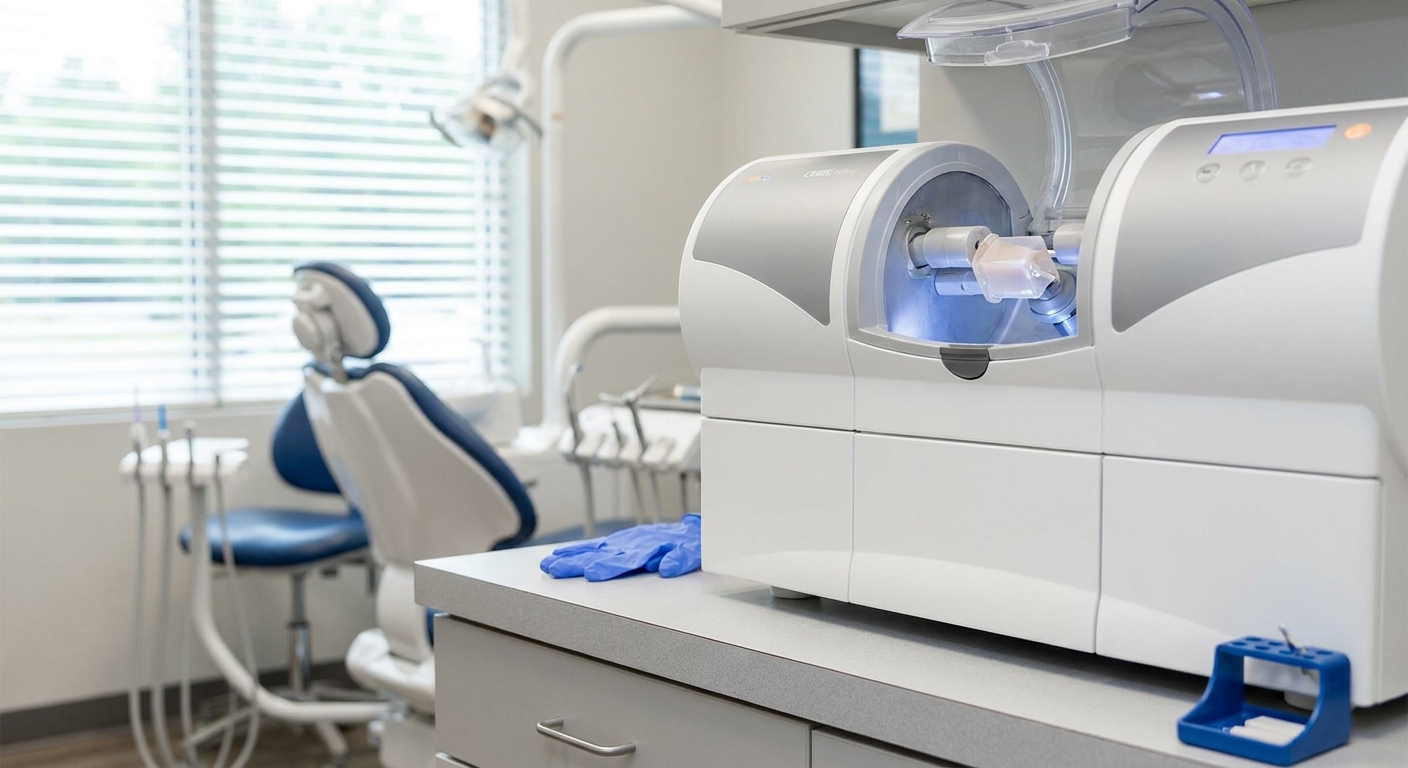
Chairside milling systems automate how the crown is made, but they do not automate the clinical decisions. A scanner captures the prepared tooth, software proposes a crown shape, and a milling unit carves the crown from a ceramic block while you wait. The dentist still has to decide whether the margin, thickness, bite, and material are appropriate, and in a single same-day appointment every one of those calls happens in one sitting.
In plain terms, the sequence works like this. The dentist numbs and shapes the tooth, scans it, and lets the software draft a design. The dentist then edits that design and sends it to the mill, and finally finishes, fits, and bonds the crown, often within about two hours. The technology is real and works well in many cases, but what it offers is speed. It does not give the dentist new information or a different way to judge fit.
Before any of that, one decision matters more than the rest: does the tooth need a crown at all? A crown is a full-coverage restoration, so our treating dentist only recommends one when there is not enough healthy structure left to protect the tooth another way. That usually means one of these situations:
- A large filling that is failing
- A cracked cusp (one of the chewing points)
- A decayed or worn tooth that has broken down
- A back tooth that has had a root canal
If a good amount of healthy tooth remains, an onlay may be enough, because it covers only the weakened or damaged part. Less dentistry is often the better dentistry, since natural tooth structure cannot be put back once it is removed. If you are concerned about being recommended unnecessary treatment, here is what you can expect: the first question is whether you need a crown, and only then does the conversation turn to material.
View Dental Raleigh still uses advanced technology throughout the process, including digital intraoral scans, digital X-rays, and clinical photos. The difference is where the checkpoints fall.
What Should Your Dentist Catch on Screen Before Anyone Makes the Crown?
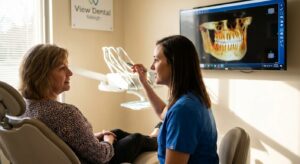
An important check happens before the crown exists. At View Dental Raleigh, the treating dentist reviews the lab’s digital design on screen and approves it before fabrication, because once a crown is made, its margin, thickness, and contacts are locked in.
After the tooth is prepared, the lab receives a complete digital package:
- A scan of the prepared tooth
- A scan of the opposing teeth
- A record of your bite
- Photos of the tooth and your smile
- Notes on shade and anything unusual about the case
When the proposed design comes back, the dentist looks at the margin line first. The margin is where the crown meets your tooth, and it needs to be traced exactly where the tooth was prepared. If the margin stops short or runs past the preparation, that edge becomes a ledge or gap where plaque collects and decay can start. Many crown problems that show up years later begin right at that edge.
Thickness comes next. Every crown material needs a minimum thickness to be strong, such as about 1.5 mm on the biting surface for lithium disilicate, and a design that runs thin over a cusp may look fine on screen but crack under chewing force months later. The dentist also checks how the crown touches the teeth beside it and the tooth it bites against. Shape matters too, especially if your teeth show signs of grinding, because a crown shaped for gentle chewing may not hold up the same way for someone who clenches at night.
Think of it like approving a blueprint before the framing goes up. Changing a line on paper costs nothing, while changing a finished wall costs a lot. You are welcome to see the design on screen and ask why a contour or edge sits where it does. The dentist would rather explain the plan than ask you to take it on faith.
What Does the Try-In Visit Catch That a Screen Cannot?
Once the design is approved and the lab finishes the crown, the second checkpoint comes at try-in. The crown is tested in your mouth before any cement or bonding agent is used. Some problems only show up on a real tooth, in real light, with a real bite, so this step may catch what a screen can miss.
At the try-in appointment, the dentist removes the temporary, cleans the tooth, and seats the crown without cement. The margins are checked with an explorer, a fine instrument that catches on any gap or ledge, and an X-ray confirms the crown is fully seated when needed. Next, floss goes through each contact. The goal is a firm snap: the floss should not shred, and it should not slide through loosely. A contact that is too open may trap food between the teeth, while one that is too tight can stop the crown from seating all the way down.
Then the dentist checks your bite. Articulating paper, a thin marking film, shows exactly where your teeth touch as you close and slide your jaw side to side. The goal is a crown that shares the load with your neighboring teeth instead of hitting first. A crown that hits first can make the tooth sore, damage the opposing tooth through wear, and lead to fracture over time. Last, the dentist looks at shade and shape in natural light and hands you a mirror, a step that matters most on a front tooth, where the cosmetic appearance of the crown is most visible.
Small refinements can be adjusted and polished chairside. If something needs more work, such as an open margin or a shade that does not match well, the crown goes back to the lab. Once a crown is bonded, removing it usually means cutting it off, so try-in is the last easy moment to say no.
Is a Temporary Crown Just a Delay, or Does It Protect the Final Fit?
Between those two visits, commonly a week or two for a single crown, you wear a temporary crown, and it does real work. A well-fitted temporary protects the tooth and gives the gums time to settle. View Dental Raleigh wants the gum tissue around the tooth healthy before the final crown goes on, because inflamed tissue makes an accurate margin harder to judge.
Shaping a tooth disturbs the gum tissue right next to it, and fresh preparation can leave the gums puffy, tender, or bleeding. Swollen tissue can hide the true edge of the preparation. If a permanent crown goes on against that swelling, the gum line may change as it heals, and a margin that looked right on delivery day can later leave a visible edge or a small gap that was not there before.
While you wait, the temporary does several jobs. It covers the prepared tooth so it is less sensitive to cold and air, helps keep nearby and opposing teeth from drifting into the space, and gives the gums a smooth, stable surface to heal against. Temporaries are not as strong as the final crown, so you will get a few simple instructions: skip very sticky or hard foods on that side, slide floss out sideways instead of popping it up, and call if the temporary loosens.
The same thinking applies before the tooth is ever prepared. If you arrive with pain or infection, that gets treated first. Good planning means knowing how to separate urgent problems from issues that can be addressed over time, and a crown placed over an unresolved problem may not stay comfortable.
Why the Right Material Depends on Your Tooth, Not the Blocks on a Shelf
Choosing a material is another place where the two workflows differ. An appropriate crown material depends on four features of your tooth: space, force, visibility, and how the crown will be held on. A chairside system can only mill the block types that office keeps in stock, while a lab can make whatever material your case calls for, from lithium disilicate to full-contour zirconia to porcelain fused to metal.
Space comes first, because every material has a minimum thickness. Monolithic lithium disilicate, a strong glass ceramic, generally needs about 1.5 mm of room on the biting surface. Full-contour zirconia can often work with less, commonly around 1 mm or slightly under on the biting surface and less on the sides. On a short tooth, a tight bite, or a tooth that has lost height, zirconia may allow a strong crown without removing more healthy tooth.
Force is next. Heavy wear, flattened edges, cracked teeth, and other signs of clenching or grinding may point toward high-strength zirconia for molars. You may also hear about a night guard, because no crown material addresses the grinding habit itself.
Visibility matters in your smile. Lithium disilicate lets light pass through much like natural enamel, so it tends to blend in on front teeth and premolars, where appearance matters most. Newer, more translucent zirconias fall between the two, since they are stronger than glass ceramics and look more natural than older zirconia.
Retention is the last factor. Lithium disilicate performs well when it is bonded, and bonding needs a clean, dry field. If the edge of the preparation sits deep under the gums where it cannot be kept dry, a material that works well with conventional cement, such as zirconia, is usually the safer choice.
Porcelain fused to metal (PFM) has a long track record and still suits some bridges and specific needs. However, it usually requires more tooth reduction, the outer porcelain can chip, and a dark line can show if the gums recede, a cosmetic drawback on visible teeth. For most single crowns, zirconia or lithium disilicate may give a stronger or more natural result with less tooth removed.
Does a Root Canal Treated Tooth Have Enough Structure Left to Hold a Crown?
Material is only part of the picture, because the crown also needs something solid to hold onto. A root canal treated tooth can hold a crown when enough sound tooth remains above the crown’s edge. That band is called a ferrule, and our treating dentist looks for roughly 1.5 to 2 mm of it. A ferrule spreads chewing stress and may help keep the tooth from fracturing. Without it, the tooth may need more work first, or it may not be a good long-term candidate.
A simple comparison helps. A ferrule works like the metal band around the end of a wooden tool handle, which keeps the wood from splitting under pressure. The crown wraps around that collar of natural tooth, and if the collar is missing, the crown rests mostly on filling material while chewing forces concentrate on a small, weak area. Root canal treated molars and premolars also tend to be more brittle, which is why covering the cusps matters so much for them.
When the ferrule falls short, you will hear the options plainly. These can include:
- A post and core buildup to rebuild the foundation
- A procedure to expose more tooth structure above the gum, sometimes done by a specialist
- An honest conversation that the tooth may not be predictably saved
That last option is not a dead end. View Dental Raleigh offers root canal therapy, crowns, extractions, and dental implants as comprehensive care under one roof. If a tooth cannot be saved with confidence, the plan can move to a replacement without starting over at a new office. This is what looking beyond the tooth that hurts today means in practice.
Judging ferrule takes imaging, careful measurement, and sometimes a decision to do more foundation work before the crown is designed. That kind of planning does not fit well inside a single two-hour appointment.
Do Lab-Made Crowns Actually Last Longer Than Same-Day Crowns?
Not necessarily. When both are placed with sound clinical steps, published comparisons generally show similar survival for chairside crowns and lab-made crowns. The real difference is process and oversight, not a weakness in the material.
Systematic reviews in the prosthodontic literature, including work published in the Journal of Prosthetic Dentistry, have generally found no meaningful survival difference between the two approaches over the medium term when the clinical steps are done well. That is worth saying plainly, because some content about lab crowns suggests that same-day crowns are inferior, and the evidence does not support that claim. A well-designed, well-fitted chairside crown can do well for many patients.
What the research does show is where the risk actually sits. Crowns may fail at the margin, where decay starts, or at the bite, where a high spot stresses the tooth. They may also fail when the material does not match the space or force, or when the foundation underneath has too little ferrule. Every one of those is a judgment call.
So if you are comparing same day crowns in Raleigh with lab-made options, one useful question is “how many times does someone check the decisions that matter, and when?” A same-day workflow compresses design review, fit, and bonding into one sitting of about two hours, with freshly disturbed gum tissue. A two-visit workflow separates them, which gives the dentist one checkpoint before fabrication and another before anything is permanent.
Why View Dental Raleigh Checks Your Crown Twice Before It Becomes Permanent
View Dental Raleigh chose a two-visit digital lab workflow because it builds in two checkpoints for margin, bite, and fit: the first when the dentist approves the design, and the second at try-in before bonding. The goal is a restoration that may stay comfortable and maintainable for years, not just one that fits fast.
You give up one extra appointment. In return, you get a temporary that lets your gums settle, a material chosen for your tooth rather than for what is in stock, the chance to see your design on screen, and a try-in where you look in the mirror before anything is cemented. Both approaches can reach similar destinations, and this path trades a little speed for more chances to catch a problem.
It is normal to have concerns before any crown, so here is how we address the common ones. If your concern is discomfort, the tooth is numbed for preparation, and try-in is usually a short visit. If you are worried about being judged for the state of your teeth, the scans and photos are there to explain what is happening, not to lecture you. And if your concern is cost, you will hear the benefits, limitations, expected maintenance, timing, and cost before anything starts. Your cost depends on the material, whether a buildup or root canal is needed first, and whether an onlay could do the job instead.
View Dental Raleigh accepts Medicaid, patient financing through a third-party payment plan, and cash pay. Adult dental benefits under NC Medicaid are set by the state program, which is run by the North Carolina Department of Health and Human Services. If you have Medicaid, the NC DHHS website is the place to review current program information, and our team can walk through what your plan means for your treatment. When the clinically appropriate plan and your budget do not line up yet, the dentist can separate the longer-term goal from the most appropriate immediate path and sequence treatment in phases.
What Raleigh Patients Ask Before Committing to a Crown
Are same-day chairside crowns as strong as lab-made crowns?
The ceramic materials themselves are comparable in strength. How long a crown lasts for a particular patient depends more on margin accuracy, bite adjustment, and choosing an appropriate material for that specific tooth. A two-visit workflow gives the dentist two separate clinical checks on those factors before the crown is permanently bonded.
Why does View Dental Raleigh use a temporary crown instead of finishing the crown the same day?
The temporary protects the prepared tooth and lets the gum tissue settle, so the final crown’s margins are judged against healthy tissue instead of swollen tissue that will change shape as it heals. Seating a crown against inflamed gums can leave an edge or gap that appears only after the crown is in place.
What does the dentist check when reviewing the crown design before it’s made?
The dentist checks four things: that the margin is traced exactly on the preparation line, that the crown is thick enough over each cusp to be strong, that the contacts with neighboring teeth are appropriate, and that the bite lets the crown share chewing load with the surrounding teeth. That last point matters most if you grind or clench.
What happens at the try-in appointment before the crown is bonded?
The dentist removes the temporary and seats the crown without cement. Margins are checked with an explorer, and with an X-ray when needed. Contacts are tested with floss for a firm snap, and the bite is marked with articulating paper. Shade and shape are reviewed in natural light, and if anything needs adjustment, the crown may go back to the lab.
What is a ferrule and why does it matter for a crown on a root canal treated tooth?
A ferrule is a band of sound tooth, roughly 1.5 to 2 mm, above the crown’s edge. It spreads chewing stress and may help prevent fracture. Without enough ferrule, the tooth may need a buildup or a procedure to expose more structure first, or it may not be a good long-term candidate for a crown.
How long does the two-visit crown process take at View Dental Raleigh?
The first visit covers preparation, digital scans of your tooth and bite, and a temporary crown. The second visit is scheduled once the lab returns your crown, commonly within a week or two for a single crown depending on the material. At that visit you have the try-in and, if the crown passes every check, bonding.
Ask These Two Questions Before Any Crown Is Made
Whether you end up choosing same day crowns in Raleigh or a lab-made crown, ask two things before your tooth is prepared. First, when does the dentist review the margin and bite? Second, what happens if the crown does not fit well at delivery? The answers will tell you more about how your crown experience may unfold than any promise about speed.
At View Dental Raleigh, you can hear those answers in person. Schedule a consultation to have your tooth evaluated, see the digital design on screen before it is made, and understand exactly what will be checked at each visit. The margin you approve on screen and confirm in the mirror is the same edge that will protect your tooth, so it deserves more than one look.
Ready to Learn Which Crown Process Is Right for Your Smile?
If you’ve been told you need a crown and aren’t sure whether same-day crowns or a two-visit process is the better choice for your situation, View Dental Raleigh is here to walk you through both options. Our team takes time to explain the differences and help you make the decision that fits your schedule, budget, and clinical needs. Reach out today to discuss your crown treatment in Raleigh.
Individual experiences with dental crowns vary based on tooth condition, oral health, material choice, and other factors unique to each patient.