Expertise provided by Calvin Chen, Owner
You bite into something and feel a sharp crack, or your dentist points to a dark spot on the X-ray and says the word “crown.” Suddenly you are searching for what that means, how many visits it takes, and whether your tooth will look normal when it is done. Often no one has explained the difference between a filling, a crown, and an implant, or why one can cost three times what another does. This guide to restorative dentistry in Raleigh is meant to close that gap. At View Dental Raleigh, we would rather you understand your options before you sit in the chair than nod along and hope for the best.
Every plan we build starts with what you ultimately want to accomplish. You may want to keep a tooth you are worried about losing, chew comfortably on both sides again, stop hiding a gap when you smile, or simply get out of pain. Once we know your goal, View Dental Raleigh completes a comprehensive exam, digital X-rays, and a digital 3D intraoral scan, so the plan reflects what is actually in your mouth and not a guess. This guide covers six things:
- What restorative dentistry includes
- How it differs from cosmetic work
- What happens at each visit
- How materials are chosen
- How complex cases are sequenced
- What treatment typically costs and how to pay for it
What Does Restorative Dentistry in Raleigh Actually Include?
Restorative dentistry is the part of dental care that repairs or replaces tooth structure lost to decay, fracture, infection, or extraction, so the tooth can work and look natural again. At View Dental Raleigh, restorative care includes fillings, crowns, bridges, single-tooth implants, and implant-supported snap-in dentures, and our DMD-trained dentist both places and restores single-tooth implants in our own office rather than sending that work elsewhere.
Each treatment answers a different amount of damage, so it helps to think of them on a scale:
- A filling patches a small area of decay, like filling a pothole before it spreads.
- A crown covers a tooth that still has a healthy root but has lost too much structure to hold a filling. It works like a protective helmet over the whole visible tooth.
- A bridge replaces a missing tooth by attaching a false tooth to crowns on the teeth on either side, the way a bridge spans a gap between two supports.
- A dental implant replaces both the missing tooth and its root. A small post is placed in the jawbone and topped with a crown.
- Root canal treatment also belongs in this group. It removes infection from inside a tooth so the tooth can be kept and later protected with a crown.
The ADA’s patient site, MouthHealthy, explains each of these procedures in plain language if you want a second source to read alongside this one.
What matters most is matching the treatment to the tooth. A tooth with a small cavity does not need a crown, while a tooth with a fracture running below the gumline may not be predictably saved by any filling or crown. That is why our exam involves looking beyond the tooth that hurts today. A cracked molar can be a sign of heavy bite forces that are stressing other teeth too, and when you know that early, you can protect those teeth before they crack.
Here is a common example. Suppose you come in for one sore tooth and the 3D scan shows two older fillings with failing edges nearby. We will tell you about all three, and we will also tell you which one needs attention now and which can be watched. You leave knowing the full picture, not just the answer to one question.
Is Restorative Dentistry Different From Cosmetic Dentistry, or Can One Treatment Do Both?
Restorative dentistry fixes a functional problem, such as decay, a fracture, an infection, or a missing tooth. Cosmetic dentistry changes the appearance of teeth that are otherwise healthy. Some treatments, especially crowns, can serve either purpose, depending on why the treatment is placed.
A crown on a cracked back molar is restorative. The crack lets bacteria in and can split the tooth if you keep chewing on it, so the crown protects function. A crown on a healthy but misshapen front tooth, placed only to change its shape or color, is cosmetic. The material and the steps can be nearly identical, but the reason behind the treatment is different, and that reason affects how insurance views it. Dental plans generally treat restorative work as necessary care and often pay part of it, while purely cosmetic treatment is usually excluded.
Many patients feel nervous about this part. You might worry that a dentist will look at your teeth and start selling you work you never asked for, or that you will be judged for how your teeth look right now. Both fears are reasonable. Our approach is to separate urgent problems from issues that can be addressed over time, and to label each one clearly. A decayed tooth that is close to the nerve is urgent. A chipped edge that bothers you in photos is your choice to make on your own timeline.
View Dental Raleigh offers both restorative and cosmetic dentistry, so patients from Raleigh, Apex, Cary, and Wake Forest get comprehensive care under one roof without starting over at another office. In practice, many plans blend the two goals. If you need crowns on two front teeth because of large old fillings, for example, we can match their shape and shade to your other teeth, which repairs function and improves appearance in the same treatment. You decide how much esthetic refinement you want, and we explain the cost difference before anything is scheduled.
How Many Visits Do Crowns, Bridges, and Implants Really Take?
At View Dental Raleigh, most crowns and bridges take two visits spaced about two to three weeks apart. A single-tooth implant takes several months, because the implant has to heal into the bone before the final crown goes on. We do not make same-day crowns or attach a tooth on the day an implant is placed. Every case begins with an exam, digital X-rays, and a digital 3D intraoral scan, and implant cases also include CBCT 3D imaging.
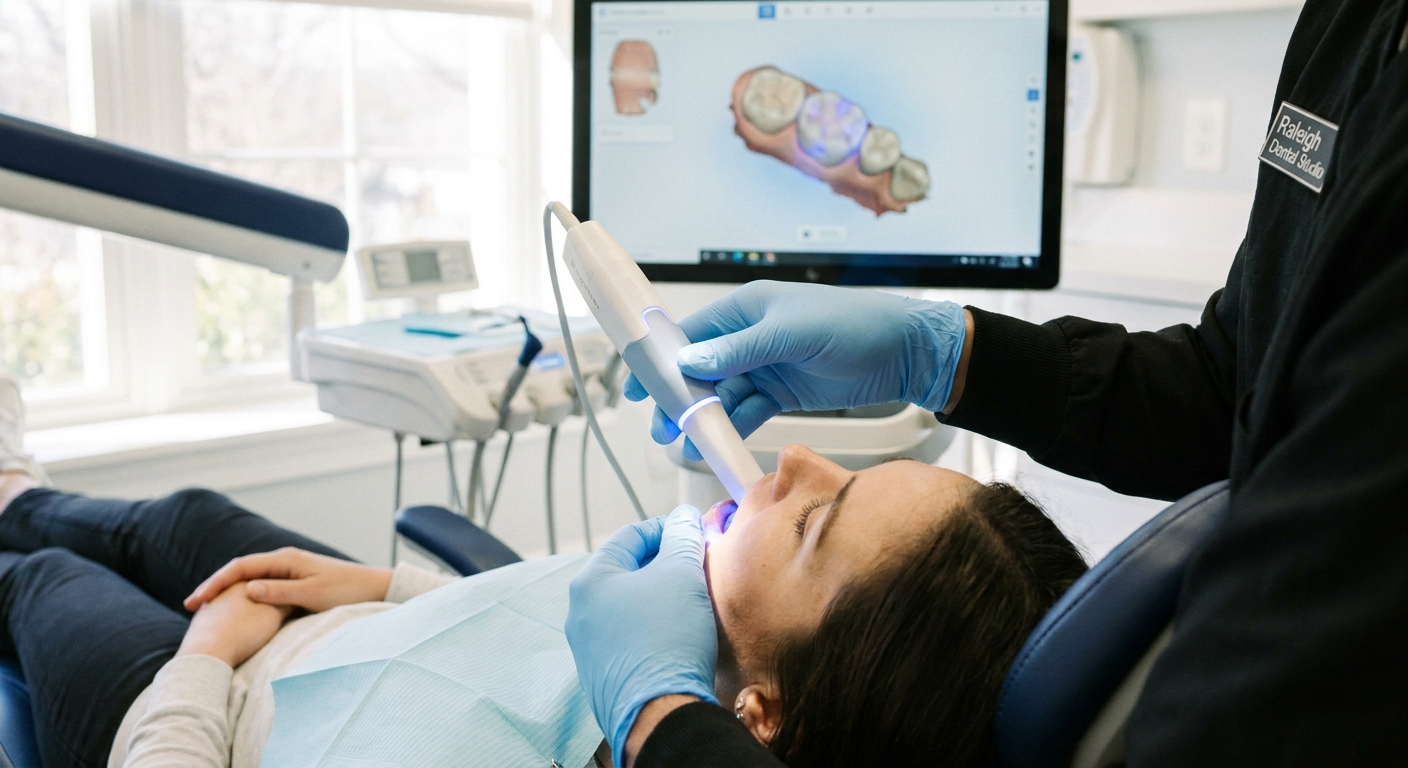
View Dental Raleigh uses 3D intraoral scanning in place of traditional putty impressions. A small wand captures a detailed digital model of your teeth and bite in a few minutes, and many patients find it far more comfortable than gagging on an impression tray. The digital model also gives the dental lab precise information about the edges of the prepared tooth and how your upper and lower teeth meet, which helps the final crown fit with fewer adjustments.
CBCT, or cone beam computed tomography, is a 3D X-ray. It shows the height and width of your jawbone and the location of nerves and sinuses, which a standard flat X-ray cannot fully show. View Dental Raleigh chose CBCT for implant planning so the surgical phase and the restorative phase aim at the same finished tooth: the implant goes where the final crown needs it, not just where bone happens to be available.
Crowns and Bridges: Two Visits Plus the Lab Phase
A crown or bridge at View Dental Raleigh is usually finished in two appointments, with a two to three week lab phase in between.
At the first visit, we numb the area, remove any decay or weak old filling material, and shape the tooth so the crown has room to fit over it. We then scan the prepared tooth and place a temporary crown so you can eat and smile normally while you wait. For a bridge, the teeth on both sides of the gap are shaped and scanned the same way.
During the lab phase, a dental lab fabricates your permanent crown or bridge from the digital scan.
At the second visit, we remove the temporary and check four things before anything is permanently cemented:
- The margins, which are the edges where the crown meets the tooth
- The contacts with neighboring teeth
- The bite
- The shade
If something is off, we correct it before the crown is cemented, not after.
Dental Implants: The Surgical Phase, Healing Period, and Restorative Phase
A single-tooth implant at View Dental Raleigh moves through three phases: planning and placement, a healing period of several months, and final restoration, all handled by the same dentist.
Planning and placement. If the tooth is still present, it may need to be removed first, and the site may need time to heal before the implant goes in. After CBCT imaging and planning, the implant post is placed in the bone.
Healing. Over the next several months, the bone bonds to the implant. This step cannot be rushed, so we do not load a final tooth on the day an implant is placed. The implant needs to stabilize first.
Restoration. Once healing is confirmed, we scan the implant and place the connector piece and final crown.
Snap-in dentures follow a similar sequence: the implants heal first, and then a denture is made to clip onto them. When a case calls for more extensive surgery than we provide in our office, View Dental Raleigh partners with an oral surgeon and coordinates the restorative plan with them.
Porcelain, Composite, or Zirconia: Why Would Your Dentist Recommend One Over Another?
Porcelain is usually recommended where appearance matters most, zirconia where chewing force is highest, and composite resin for most fillings. At View Dental Raleigh, the recommendation depends on four things:
- Which tooth is being restored
- How much force that tooth takes when you chew
- How visible it is when you smile
- How much natural tooth structure remains
The National Institute of Dental and Craniofacial Research describes how dental materials differ in strength, wear, and appearance, and those differences are why no single material is right for every tooth. Here is how they usually compare:
| Material | Typical use | Strength | Appearance | Cost tendency |
|---|---|---|---|---|
| Composite resin | Fillings, small repairs | Good for small and medium areas | Tooth-colored, can be shade-matched | Lowest |
| Porcelain (ceramic) | Front crowns, visible teeth | Strong, can chip under heavy force | Most lifelike translucency | Moderate to higher |
| Zirconia | Back molars, bridges, heavy biters | Very high | Natural, slightly less translucent | Moderate to higher |
For fillings, the evidence is more reassuring than many patients expect. A systematic review reported by ADA News found general equivalence among commonly used restorative materials. In other words, a well-placed filling in a well-chosen material matters more than chasing one “best” product. We think about crowns the same way: the material has to suit the tooth, and the fit has to be right.
Here is how that plays out. If you grind your teeth at night and need a crown on a lower molar, zirconia may be a better choice because it resists forces that would chip a more brittle ceramic. If you need a crown on a front tooth next to natural teeth, porcelain often blends better. Either way, we will walk you through the benefits, limitations, expected maintenance, timing, and cost of each option.
On durability, crowns are commonly expected to last 10 to 15 years, though individual experiences vary. Implants can last much longer when the surrounding gum and bone stay healthy. Grinding, new decay at the edges, and skipped cleanings all can shorten that lifespan.
What Happens When Several Teeth Need Work at Once?
When several teeth need restorative work, View Dental Raleigh builds a phased treatment plan. The plan controls infection and decay first, then restores function, then refines esthetics, with each phase set up to support the next. Complex cases often take several months, because healing sets the timeline, not convenience.
A mouth with several broken, decayed, or missing teeth can feel overwhelming, but it is not a dead end. The first job is to sort teeth into three groups:
- Teeth that can be predictably saved
- Teeth that are questionable
- Teeth that are hopeless and are better removed
From there, we separate the ideal destination from the most appropriate immediate path. The ideal destination might be implants and crowns on both sides. The immediate path might be removing the infected teeth, treating deep decay, and adding an interim tooth replacement, such as a flexible partial denture, while you plan the next phase around your budget.
Sequencing matters because each step changes the next one. An implant has to heal before a final crown can be designed for it, and if a crown on the neighboring tooth is made too early, its shape may not line up with the implant crown later. This is exactly why View Dental Raleigh pairs CBCT imaging with digital scanning: the same 3D data guides where an implant is placed and how the crowns around it are shaped, so planning, communication, and execution all point toward one bite. The ADA publishes evidence-based clinical practice guidelines that dentists use to ground decisions like these in research rather than habit.
Rushing a complex case is where things can go wrong. Crowns placed on teeth with untreated infection can fail, implants loaded before they heal can loosen, and a bite rebuilt without checking how the jaw closes can lead to cracked new restorations. We are not simply trying to fix one problem and move on. We are building a mouth that stays comfortable and maintainable for years, and when part of a case needs an oral surgeon, we coordinate the plan so you are not stuck relaying messages between two offices. For restorative dentistry Raleigh patients can actually plan around, that coordination matters as much as the dentistry itself.
Will Restorative Work Hurt, and What If You Are Nervous About Long Appointments?
Restorative procedures at View Dental Raleigh are done with local anesthetic, so the tooth and surrounding area are numb during treatment. View Dental Raleigh does not offer IV sedation or nitrous oxide in the office. Instead, we focus on clear explanations, planned breaks, and appointment lengths you know in advance.
Most nervous patients are not afraid of just one thing. They are afraid of several:
- That it will hurt
- That the appointment will drag on
- That the results will take forever
- That someone will lecture them about how long it has been
Saying those fears out loud is the first step to handling them. Before your first restorative visit, we explain how long it should take, what you will feel, and how to signal if you need a break. The switch from putty impressions to a quick intraoral scan also removes one of the steps anxious patients dread most. If a long visit feels like too much, we can often split the work into shorter appointments as part of your sequence.
Recovery depends on the procedure. After a crown preparation, it is common to have mild gum soreness and some temperature sensitivity for a few days, and over-the-counter pain relievers usually manage that. After implant placement, expect soreness and some swelling for several days, along with specific instructions about eating and cleaning the area. If pain gets worse instead of better, call us. That is a signal to be seen, not something to wait out.
For many patients, the biggest worry is not knowing what the result will look like, and seeing a real result helps. View Dental Raleigh shares documented before-and-after cases from our own patients on Instagram, including one patient who traveled from Fayetteville to have her smile restored before her wedding. These are not stock photos. They show what restorative and esthetic work looks like on real people treated in our Raleigh office.
What Will Restorative Dentistry in Raleigh Cost, and How Can You Pay When Insurance Falls Short?
Restorative dentistry nationally often falls within these general ballpark ranges before insurance:
- Fillings: about $150 to $450
- Crowns: about $800 to $1,500
- Three-unit bridges: about $1,500 to $5,000
- Single implants, including the crown: about $3,000 to $5,000
View Dental Raleigh does not publish set prices for major cases. We give you a written estimate for your specific case after your exam and 3D imaging, because your actual cost depends on what the images show.
| Treatment | Common ballpark range | What moves the price |
|---|---|---|
| Filling | $150 to $450 | Size, number of surfaces, material |
| Crown | $800 to $1,500 | Material, build-up needed, lab fees |
| Three-unit bridge | $1,500 to $5,000 | Material, number of units, condition of anchor teeth |
| Single implant with crown | $3,000 to $5,000 | Extraction, bone grafting, crown material |
These ranges are general reference points, not quotes from our office. Prices change based on material choice, how much tooth structure must be rebuilt, lab fees, and extra steps such as extractions or bone grafting. Two people who both “need a crown” can have very different bills, since one tooth may need only a crown while another needs a core build-up and treatment for infection first.
Insurance usually helps with restorative care, but it rarely covers all of it. Many plans pay a share of fillings, crowns, and bridges after the deductible, up to an annual maximum. Implants are sometimes covered only partly or not at all, and purely cosmetic work is usually excluded. Because annual maximums reset, a phased plan can sometimes spread care across two benefit years for the best value path. View Dental Raleigh accepts Medicaid. What Medicaid pays for depends on your specific plan and eligibility, so we review your benefits with you before treatment.
If your benefits do not cover everything, View Dental Raleigh works with third-party financing such as CareCredit and Cherry, which may let qualified patients divide treatment into monthly payments, and cash-pay patients are welcome too. We prefer to talk about financing after your exam and imaging. That way you are looking at a real number for a real plan, and the plan fits your financial reality as well as your clinical needs.
Why Do Raleigh Patients Trust View Dental Raleigh With Restorative Work?
View Dental Raleigh shows you your own diagnostic images before any restorative work begins, explains your options and materials in plain language, and keeps single implants, bridges, and snap-in dentures under one roof. When something falls outside our scope, we partner with an oral surgeon and stay involved in the plan.
Training matters for restorative and implant work, because small planning errors can become expensive later. The treating dentist at View Dental Raleigh holds a DMD and has completed hundreds of hours of implant-focused continuing education, an investment of more than $100,000 in advanced clinical training, to support the placement and restoration of implants, bridges, and snap-in dentures. Our advanced technology supports the same goal of better planning and fewer surprises:
- Digital 3D intraoral scanning
- CBCT 3D imaging
- Digital X-rays
When you can see your own scan on the screen, a recommendation stops being something you have to take on faith.
Proof should come from the office you are trusting. Our documented before-and-after cases, like the Fayetteville wedding patient, show what “natural-looking” means in practice: shade matching, crown shape, and how a restoration sits next to natural teeth.
Our care is compassionate and customized because no two mouths, budgets, or goals are the same. One patient wants the fastest path out of pain. Another wants a long-term roadmap that ends with implants. A third needs to start with whatever Medicaid allows and build from there. Each of those plans is legitimate, and each one starts the same way: we listen, we image, and we explain. That is what restorative dentistry Raleigh families can rely on from us.
Frequently Asked Questions About Restorative Dentistry at View Dental Raleigh
Most crowns and bridges at View Dental Raleigh take two visits, implants take several months, and every plan starts with 3D imaging and a written estimate. Here are short answers to the questions patients ask most often.
How many visits does it take to get a crown or bridge at View Dental Raleigh?
Usually two. The first visit includes tooth preparation, a digital scan, and a temporary crown. About two to three weeks later, the second visit is for checking fit, contacts, and bite, then cementing the permanent crown or bridge. We do not make same-day crowns. The exam and imaging may happen at an earlier appointment.
What is the difference between a crown, a bridge, and a dental implant?
A crown covers a damaged tooth that still has a healthy root. A bridge replaces a missing tooth by anchoring to crowns on the neighboring teeth. An implant replaces both the missing tooth and its root with a post in the jawbone topped by a crown, so the neighboring teeth do not need to be reshaped.
Does dental insurance cover restorative dentistry like crowns and implants?
Many plans pay a share of crowns and bridges after the deductible, up to an annual maximum. Implants may receive limited or no coverage depending on the policy. View Dental Raleigh accepts Medicaid and reviews your benefits with you before treatment so you know your share in advance.
How much does a dental crown cost in Raleigh without insurance?
Crowns commonly range from about $800 to $1,500 per tooth nationally, depending on material, how much rebuilding is needed, and lab fees. View Dental Raleigh gives a written estimate after your exam and 3D imaging, and financing through CareCredit or Cherry may be available for qualified patients.
Can View Dental Raleigh help if you are nervous about restorative work?
Yes. Treatment is done with local anesthetic, impressions are taken with a digital scanner instead of putty, and we explain timing, what you will feel, and how to take a break before we start. View Dental Raleigh does not offer IV sedation or nitrous oxide, but splitting work into shorter visits and knowing exactly what to expect makes a real difference for many nervous patients.
How long does a dental crown or implant last before it needs replacement?
Crowns are commonly expected to last 10 to 15 years with good care, though individual experiences vary. Implants can last much longer when the surrounding gum and bone stay healthy, because grinding, new decay, and missed cleanings can shorten lifespan, so regular checkups matter.
Your next step is a restorative consultation at View Dental Raleigh. At that visit, you will see your own digital X-rays and 3D scans, review your treatment options and material choices, and get a written cost estimate before any work begins. When you come in, ask the dentist to mark which items on your plan are urgent and which can wait. That one question turns a long list into a sequence you can actually plan around, both for your mouth and for your budget.
Ready to Restore Your Smile?
If you’ve been putting off treatment because you’re unsure about the process or cost, the team at View Dental Raleigh can walk you through your options in plain terms. A conversation about what’s possible for your specific situation costs nothing but a few minutes of your time. Reach out today to discuss how restorative dentistry can help you feel confident about your smile again.
Individual results vary, and treatment recommendations depend on your exam and imaging.