
How to Find the Best Dentist in Raleigh, NC: 10 Questions to Ask First
You finally sit down to compare dentists in Raleigh, and every single practice website seems to say the same thing: gentle care, advanced technology, accepting new patients. The reviews all look good. The offices all look clean. So how do you actually choose? Finding a dentist in Raleigh, NC is not about reading more marketing copy. It is about asking ten specific questions before you ever walk in the door, because the answers tell you far more than any star rating can.
These are the questions we would ask if we were choosing a dental home for our own family. Each one is designed to help you understand how a practice listens and plans.
1. What Credentials Has the Best Dentist Raleigh NC Earned Beyond Dental School?
Ask what the dentist has studied since graduation, especially in the services your family actually needs. A dental degree is the starting point, not the finish line.
Our lead dentist at View Dental Raleigh has pursued extensive continuing education since earning a DMD, with particular focus on complex restorative cases and full-arch rehabilitation. This includes hands-on surgical courses, advanced prosthetic design workshops, and multi-day intensives on managing complications when implant or reconstruction cases require mid-treatment adjustments. That training, built up over years rather than acquired in a single weekend seminar, shapes how we approach everything from a simple crown to a full-mouth restoration.
Why does this matter for you? When you ask this question and hear a specific answer, such as named programs in particular treatment areas rather than a vague “we stay current,” you learn whether this is a dentist who continually works at developing their skills. That gives you insight into how a practice approaches patient care.
2. What Modern Technology Does the Practice Use, and Why Did They Choose It?
The right answer is never just a brand name. It is what the tool does for your diagnosis and your understanding of your own mouth. Technology should make the conversation clearer, not fancier.
At View Dental Raleigh, we use modern digital scans, meaning intraoral 3D scans, along with digital X rays and CBCT 3D imaging. We chose digital scans over relying entirely on traditional physical impressions because they capture your anatomy, your bite, and your restorative information in a way that integrates with the rest of the digital workflow.
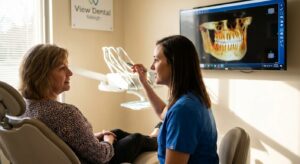
Just as important, current images let both you and the dentist see changes over time. Instead of hearing a verbal description of a problem you cannot see, you look at the actual image together. First, we show you what is happening now. We then compare it to earlier records if you have them. We also walk through what the options mean before anyone talks about scheduling. That keeps the whole conversation focused on education rather than selling, which is what many patients want when real money is on the line.
3. Does the Practice Sequence Treatment Around My Goals, or Expect Me to Fit My Life Around Theirs?
Ask whether the dentist plans treatment around your real-life timeline and budget, or simply hands you one large plan and expects compliance. Some practices sequence care in phases.
Here is an example of what that can look like. A patient who had driven up from Fayetteville came to our Raleigh office in dental pain while preparing for her second wedding. We took time to understand the goal that mattered most to her: to smile confidently on her wedding day.
That informed how we planned her care. First, we eliminated the infection. We then removed the teeth that could not be saved and restored the ones that could. We also provided an aesthetic flexible partial denture, sequenced around her wedding date and her budget rather than presenting one large plan all at once. We asked about her priorities, so a rushed exam would have addressed only the pain and missed both the larger restorative need and the goal she shared with us.
4. What Services Does the Practice Offer In-House, and What Gets Sent Elsewhere?
Ask what happens under one roof and what gets referred out, because bouncing between providers can mean no single dentist has the full picture of your oral health. Comprehensive care under one roof can be an advantage when your case involves more than a cleaning.
View Dental Raleigh offers general dentistry, preventive care and cleanings, cosmetic dentistry, and restorative dentistry. We also handle emergency dentistry, root canal therapy, dental crowns, bridges, full and partial dentures, and tooth extractions. That range can matter when a problem turns out to be bigger than you expected.
Think about the difference in practice. If a family member needs an extraction and later a partial denture, one team already knows the history, the imaging, and the bite. Nothing gets lost between offices, and no one asks you to repeat the same story three times. When you ask this question and a practice can point to comprehensive care under one roof, you are looking at a place designed to follow your family through routine visits and complex ones alike, without shuffling you across town.
5. What Insurance and Financing Options Does the Practice Accept?
Ask directly what the practice accepts before you commit to a treatment plan you cannot afford.
View Dental Raleigh accepts Medicaid, Cherry financing, and cash pay. In Raleigh, that first item matters more than some families realize. Not all practices accept Medicaid, and others that do may have wait times, which affects real access to care. You can confirm which offices participate through the state’s official list of Medicaid dental providers, which is a good first filter before you ever call.
We built our approach this way to meet families where they already were. Cherry financing spreads larger treatment across manageable payments, and cash pay keeps things simple for patients without coverage. When a practice can explain benefits, limitations, and cost in plain language up front, you spend less time worrying about surprise bills. You can also cross-check any Medicaid claim against the same state provider list so you are never guessing.
6. How Does the Practice Handle Dental Emergencies?
Ask whether you will be seen the same day or told to wait, because a toothache at six in the morning does not care about anyone’s regular schedule. When you are searching for care near you in an emergency, some practices keep room for urgent visits and others do not.
We have seen too many patients show up after spending a night in an emergency room for dental pain, where they received antibiotics and temporary relief but no actual repair to the broken tooth or infected root. An emergency room can help with pain for a night, but it usually cannot fix the tooth, and many families end up paying both the ER bill and the dental bill when the problem flares again days later.
View Dental Raleigh keeps emergency appointments available so patients can often be seen quickly when a tooth breaks, an infection flares, or pain will not let up. When you call a practice with this question, listen for a specific answer. “We hold time for emergencies and can often see you today” tells you something real, while “we will put you on a list and call you back” tells you something too. The goal is to help you get out of pain, then plan the longer-term repair once the crisis has passed.
7. Will the Dentist Explain Every Option, Including Doing Nothing for Now?
A dentist should lay out your reasonable choices, including the option to wait when appropriate, and explain the benefits, limitations, maintenance, timing, and cost of each. A practice that presents only one plan and pushes you to sign it that day may not be respecting your right to decide.
Informed consent means you hear more than one path regarding your options when more than one exists, along with an honest account of what may happen if you delay. That is the standard every dentist should meet, not a special feature.
In practice, this looks like separating what is urgent from what can wait. Consider a patient who came in with dental pain while preparing for her wedding: we treated the infection first, removed teeth that could not be saved, restored the salvageable teeth, and timed an aesthetic solution to her real deadline. First, we tell you what needs attention now to protect your health. We then explain what might be appropriate over the long term, and we are honest that the ideal destination and the most appropriate immediate path are not always the same thing. We also make clear when a smaller step today keeps the door open for larger work later, so that if a first choice does not solve everything, it was not a dead end. You deserve enough information to weigh your own priorities.
8. How Does the Practice Track Changes in My Oral Health Over Time?
Ask whether the dentist uses objective records to show you what is changing, or relies on memory and a quick verbal judgment. A helpful answer involves images stored in your record that can be compared side by side at visits.
Digital X rays, CBCT 3D imaging, and intraoral scans kept in your patient file let you and the dentist look at the same tooth across months and years. You can see whether a small crack is getting worse, whether an old filling is beginning to fail, or whether gum pockets are improving with better home care. That turns a subjective “it looks a little worse” into something you can actually see for yourself, which is why we chose modern digital scans that integrate with the rest of the workflow rather than a drawer full of physical impressions.
This matters for families most of all, because oral health is a long game. A child’s developing bite, a partner’s grinding wear, your own aging fillings: these change slowly, and slow changes are easy to miss without a baseline. When a practice can pull up last year’s scan next to today’s, they may catch problems early, while they are small and less expensive to address. That is one advantage of technology used for education. It keeps the conversation focused on teaching you rather than selling you.
9. Can I Meet the Dentist Before Committing to Treatment?
Ask whether you can sit down for a consultation before scheduling extensive work. A practice confident in its dentist-patient relationship will welcome the chance to answer your questions first.
A consultation visit gives you time to explain your concerns, hear how the dentist thinks through your case, and decide whether this is someone you trust before you commit your family’s care and your money. You learn a lot in that first conversation. Does the dentist ask what brought you in and what a good outcome would look like for you, the way a good team asks about a patient’s real goal instead of stopping at the toothache, or do they move straight to a plan without hearing your priorities?
Pay attention to how questions are handled. A dentist who slows down, uses your images to explain, and gives you room to think is showing you how future visits may go. One who seems rushed or annoyed by questions is showing you that too. For a family choosing a long-term dental home, this step is worth the extra appointment. You are not just choosing a procedure. You are choosing someone who may guide your family’s care for years, and you deserve to know how they listen before you say yes.
10. What Happens If I Am Not Happy with My Results?
Ask directly how the practice handles adjustments, discomfort, and outcomes that need a second look, because not every result is perfect on the first try, and honest dentists say so. The answer tells you how a practice behaves after the work is done, when you have less leverage.
Get specifics. Ask whether follow-up adjustments are included in the original treatment fee, especially for full and partial dentures and crowns that often need fine-tuning after you have worn them a while. Ask how the practice handles post-treatment discomfort and who you call if something feels off after hours. For cosmetic cases, ask what the revision policy looks like if the shade, shape, or fit is not what you agreed to.
A practice that stands behind its work will answer these plainly, without getting defensive. A flexible partial denture, for example, is the kind of restoration that may need small adjustments as tissues settle, and a practice should plan for that from the start. When you hear clear commitments to follow-up rather than vague reassurance, you are looking at a team that treats you as an individual.
Ask these ten questions and the marketing language falls away, leaving you with a real sense of how a practice actually works. If you want to see how those answers sound in person, call View Dental Raleigh to schedule a consultation and ask every one of them before you commit your family’s care.
Ready to Ask the Right Questions?
Finding a dentist in Raleigh, NC who truly fits your needs starts with knowing what to ask. If you’ve been putting off your search because you’re unsure where to begin, or you want a practice that takes time to answer your questions honestly, View Dental Raleigh is here to help. We believe an informed choice is a confident choice, and we’re happy to walk you through what makes our approach to general dentistry different.
Individual experiences with dental treatment vary. Patient outcomes and satisfaction depend on many factors unique to each person, including their oral health status, treatment choices, and individual healing response.