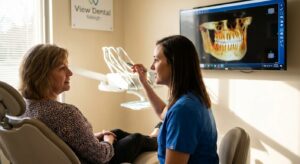

Dental anxiety is not a quirk or an overreaction. It’s one of the most common barriers to healthcare in the United States, and finding the right dentist for nervous patients can be the difference between decades of avoidance and finally getting your mouth healthy again.
Why Dental Anxiety Is More Common Than You Think
According to a 2023 survey published in the Journal of Dental Research, approximately 36% of the U.S. population reports some level of dental anxiety, and around 12% experience dental phobia severe enough to cause complete avoidance of care. That’s tens of millions of people quietly skipping appointments, managing pain at home, and feeling ashamed about something that is, at its core, a recognized clinical condition.
The American Dental Association classifies dental anxiety as a legitimate psychological barrier to care, not a personality flaw. What this means in practice: if you have been avoiding the dentist for years, you are not unusual, and you are not beyond help. The practices built to serve patients like you exist specifically because the standard dental model does not work for everyone.
The first step is stopping the self-blame and starting the search for a provider who has actual systems in place for people in your situation.
The Single Most Important Quality: Genuine Experience with Anxious Patients
There is a meaningful difference between a dentist who is generally pleasant and one who has developed specific, practiced protocols for anxiety management. Patience is a personality trait. Anxiety-informed care is a clinical skill.
A 2021 study published in the European Journal of Oral Sciences followed 340 patients with moderate-to-severe dental fear across two provider types: general practitioners with no anxiety-specific training, and dentists who had completed structured communication and behavior management training. Patients treated by anxiety-trained providers were 2.4 times more likely to complete their full treatment plan and reported significantly lower perceived pain scores during procedures.
What this means in practice: when you call a prospective dentist, ask directly how many anxious patients they treat each week and what their specific protocol looks like. A general answer like “we’re very gentle here” is not the same as “we offer a pre-appointment consultation, we use tell-show-do technique at every visit, and we have a stop signal system that every patient learns before we begin.” The specificity of the answer tells you everything.
Sedation and Comfort Options to Ask About
Sedation dentistry has matured significantly over the last two decades, and for nervous patients it is not about being knocked unconscious. It is about having options that match your anxiety level to the right level of support. A 2022 report from the American Dental Society of Anesthesiology confirmed that when used appropriately with proper screening and monitoring, all three primary sedation options carry strong safety profiles for medically stable adults.
Nitrous Oxide: The Entry-Level Option
Nitrous oxide, commonly called laughing gas, works by slowing the central nervous system’s stress response without putting you to sleep. You remain fully conscious and responsive, but the physical sensations of anxiety, racing heart, tight shoulders, shallow breathing, are significantly reduced. It’s delivered through a small mask over your nose and begins working within minutes.
A 2020 meta-analysis in the Journal of Dental Anesthesia and Pain Medicine reviewed 18 clinical trials covering nitrous oxide use in adult patients with mild-to-moderate dental anxiety. Participants reported a 61% average reduction in anxiety scores compared to no sedation. The other major advantage: it clears your system in about five minutes after the mask is removed, which means you can drive yourself home.
Nitrous oxide suits patients who feel anxious but can still communicate and cooperate during a procedure. If the sound of the drill triggers your anxiety but you’re not in crisis-level fear, this is typically the right starting point.
Oral Conscious Sedation
Oral conscious sedation involves taking a prescribed medication, usually a benzodiazepine such as diazepam (Valium) or triazolam (Halcion), roughly an hour before your appointment. You remain conscious and can respond to the dentist, but most patients describe the experience as feeling deeply relaxed and only vaguely aware of what’s happening. Many have limited memory of the appointment afterward.
Research published in the journal Anesthesia Progress found that oral sedation reduced procedural anxiety scores by an average of 72% in patients with moderate-to-severe dental fear. It is appropriate for patients who cannot relax with nitrous alone, who have a strong gag reflex, or who need to complete lengthy treatment in a single session.
You will need a responsible driver to take you home. Your dentist should also conduct a full health history review and medication check before prescribing, because benzodiazepines interact with certain medications and conditions.
IV Sedation and Sleep Dentistry
IV sedation delivers sedative medication directly into the bloodstream through a vein, typically in the arm, which allows the dentist to precisely control the depth of sedation throughout the procedure. You remain technically conscious, meaning you can breathe on your own and respond to commands, but you are deeply relaxed and will have little to no memory of the appointment.
This level of sedation is appropriate for patients with severe dental phobia, strong gag reflexes, or those undergoing extensive procedures such as multiple extractions or full-mouth reconstruction in one visit. When evaluating providers for IV sedation, look for dentists who have completed post-graduate training through an accredited anesthesia program or who work with a certified dental anesthesiologist. This is a higher level of care and the qualifications of whoever is administering it matter.
How the Office Environment Affects Your Experience
The physical environment of a dental practice is not a cosmetic detail. It is a clinical variable. A 2019 study in the International Journal of Environmental Research and Public Health examined anxiety levels in patients across dental offices with standard clinical design versus offices designed with sensory comfort in mind, including softer lighting, nature imagery, reduced ambient sound, and calming scent. Patients in comfort-designed environments showed a 34% reduction in pre-treatment cortisol levels, a direct physiological marker of stress.
When you visit a practice for the first time, pay attention to what your nervous system notices before your brain has a chance to analyze anything. Does the lighting feel harsh or calm? Is the reception area noisy or quiet? Do you smell antiseptic the moment you walk in? These are not trivial observations. They are accurate previews of how your body will feel in the treatment chair.
What a Comfort-Forward Office Actually Looks Like
A practice built for anxious patients invests in the details that reduce sensory overload. This includes private treatment rooms rather than open-bay layouts, TVs or ceiling-mounted screens for distraction during procedures, the option for noise-canceling headphones, and warm rather than fluorescent lighting. Some offices offer weighted blankets, neck pillows, or sunglasses to block the overhead light.
Distraction during procedures is not a gimmick. A 2022 study in the journal Pain Management Nursing found that patients who watched a preferred video during dental procedures reported 28% lower perceived pain intensity compared to controls. Distraction works by occupying the attentional resources the brain would otherwise dedicate to amplifying pain and fear signals. The right office treats these tools as part of the clinical environment, not optional perks.
You can find practical, in-the-moment strategies for managing what you feel during treatment once you know what to expect, but the environment you’re sitting in shapes how effective those strategies will be.
Communication Style: The Difference Between Tolerating You and Understanding You
The “tell-show-do” technique is a structured communication method where a dentist explains what they are about to do, shows you the instrument or demonstrates the sensation, and then proceeds. It was developed in pediatric dentistry and has since been validated for adults with dental anxiety. A 2020 study in the journal Patient Education and Counseling followed 280 adult patients with high dental anxiety through six-month treatment courses. Patients treated by providers who consistently used tell-show-do reported significantly lower anxiety at follow-up appointments, suggesting the method builds cumulative trust, not just immediate comfort.
Equally important is the stop signal. A good anxiety-informed dentist establishes a clear, agreed-upon signal, typically a raised hand, that means “pause immediately” before the appointment begins. Knowing that control exists changes the psychological experience of the procedure entirely.
During your first consultation, notice whether the dentist asks about your anxiety history before you bring it up. A provider who proactively inquires about past dental trauma and your specific fears is operating from a patient-first model. One who waits for you to disclose, or who brushes past it, is using a standard model and hoping for the best.
What to Look for in the Front Desk and Support Staff
Your anxiety does not start when you sit in the chair. For most nervous patients, it starts when you pick up the phone to book the appointment, or when you walk through the front door and wait to be called. A 2021 study from the Journal of Healthcare Management found that administrative interactions accounted for 41% of variance in patient-reported experience scores, meaning how the front desk treats you is nearly as influential as the clinical care itself.
A trauma-informed front desk does not make you feel judged for disclosing that it has been three years, or seven years, or fifteen years since your last visit. Staff who have been trained to work with anxious patients will never use pressure-based language, will offer clear explanations of what to expect before you arrive, and will treat your first call as a conversation rather than a transaction. If the person who answers the phone makes you feel rushed, dismissed, or embarrassed, that is accurate information about how the practice operates.
Questions to Ask Before You Book an Appointment
Approaching a dentist’s office as a two-way evaluation rather than a one-way request changes your experience before the appointment even happens. A 2019 paper in the European Archives of Paediatric Dentistry (which also included adult anxiety cohorts) found that patients who asked specific pre-appointment questions reported 33% lower anxiety scores at their first visit compared to patients who did not.
The questions that yield real information are direct. Ask: how do you handle patients who need to pause or stop mid-procedure? Do you offer a consultation appointment before any clinical work begins? What is your specific approach to pain management during treatment? What sedation options do you have available, and who administers them? What happens if I become too anxious to continue?
The quality of the answers tells you more than any website language can. A practice that supports nervous patients will answer these questions confidently and without making you feel like a burden for asking.
Special Considerations for Different Types of Nervous Patients
Dental anxiety presents differently depending on age, past experience, and what’s driving the fear. The right practice recognizes that one approach does not serve every nervous patient equally.
Children and Teens with Dental Fear
Early dental anxiety has long-term consequences. A 2020 longitudinal study published in the International Journal of Paediatric Dentistry tracked children with high dental anxiety from age eight through their mid-twenties and found that 68% continued to avoid or delay dental care as adults. The trajectory set in childhood is sticky.
For parents in Raleigh searching for care for an anxious child, the key distinction is whether a family practice has child-specific anxiety protocols or simply sees children alongside adults with no specialized approach. Ask specifically: do you offer child-oriented tell-show-do introductions? Do you have a policy around the first “happy visit” before any clinical work begins? Does your team have training in pediatric anxiety management? A “we love kids” answer is not the same as a “yes” to any of those questions.
Adults Who Have Avoided the Dentist for Years
Shame is often a bigger barrier than pain for adults who have delayed care. Many patients walk in apologizing before the exam begins, bracing for a lecture. A 2022 survey by the Oral Health Foundation found that 45% of adults who reported dental avoidance cited embarrassment about the state of their teeth as a significant factor in continued avoidance. The fear of judgment compounds the clinical problem.
A practice that handles returning patients well has a non-judgmental intake process built into the culture, not just the language on its website. Clinically, returning after years away is manageable. Gum inflammation responds to treatment. Decay can be staged and addressed in phases. Understanding what to expect when you finally face that fear can lower the barrier to making the call.
What matters on a first visit after a long absence is that the clinical findings are communicated clearly and without blame, and that treatment is presented as a realistic, phased plan rather than an overwhelming list of everything wrong at once.
Seniors with Compounding Medical Anxiety
Older patients frequently arrive with anxiety that is layered rather than simple: fear of pain, yes, but also concern about medication interactions, anxiety around a chronic health condition, sensory sensitivities, and sometimes mobility limitations that make the treatment chair itself uncomfortable.
A practice that serves seniors well coordinates with other providers when needed, takes a careful and complete health history before any procedure, paces appointments to allow for more frequent breaks, and communicates treatment options in plain language without rushing. Accessibility matters too. Physical access, clear signage, adequate parking, and front-desk staff who are patient with slower conversations are not minor considerations for this population.
Red Flags to Avoid When Choosing a Dentist
Some behaviors in a dental practice are genuinely warning signs, not just personal preferences.
A dentist who dismisses your anxiety with language like “it’ll be quick” or “you’ll be fine” has not acknowledged your experience. That dismissal typically continues through treatment. A practice that pressures you to book an extensive treatment plan at a first visit, before you have had time to process the information or ask questions, is not operating in your interest. The absence of clear sedation options in a practice that claims to serve anxious patients is a gap worth noting. Front desk staff who make you feel judged for your gap in care should be treated as a preview of the practice’s culture.
A 2020 study in Patient Experience Journal found that patient trust was the single strongest predictor of treatment compliance in dental care, more influential than cost, location, or convenience. Trust is built through how the practice behaves, not what it says on its homepage.
Finding a Dentist for Nervous Patients in Raleigh
Raleigh and the greater Triangle area have a strong concentration of dental practices, which means the options for anxious patients are real but require some navigation to find the right fit.
Start with a practice’s website and look for specific language. Generic phrases like “we cater to nervous patients” are less meaningful than explicit descriptions: whether the practice names the sedation options it offers, whether team bios mention communication philosophy or anxiety experience, and whether the site has a dedicated section for patients who are new after a long absence.
Google reviews are more useful than overall star ratings when you are looking for an anxiety-friendly practice. Search the reviews specifically for words like “nervous,” “anxiety,” “scared,” or “hadn’t been in years.” Patient experiences from people in your situation are more predictive of your experience than general praise.
For Spanish-speaking families in Raleigh and the surrounding area, language access is a specific barrier to dental care. Anxiety is harder to communicate in a second language, and a bilingual practice removes that friction entirely. When calling to inquire, ask directly whether any staff or providers are fluent in Spanish.
When you call, treat that first conversation as part of your evaluation. Ask one direct question about their anxiety protocol and notice whether the response is confident and specific or vague and generalized. That single call gives you more information than any online review.
What to Try This Week
Pick one practice in Raleigh, visit their website, and look for two things: explicit language about how they handle anxious patients, and a clear description of sedation options. If both are present, call and ask one direct question. Ask how they handle a patient who needs to stop mid-procedure. The answer tells you whether their anxiety care is practiced or just marketed. That one step, a website check and a single phone call, breaks the avoidance pattern without requiring you to commit to anything.
Frequently Asked Questions
How do I know if a dentist genuinely specializes in anxious patients or is just saying that?
The clearest signal is specificity. Ask the dentist or staff member directly what their protocol looks like for a nervous patient from the first phone call through the appointment. A practice that genuinely works with anxious patients will describe concrete steps: a pre-appointment consultation, tell-show-do communication, a stop signal, and specific sedation options. Vague reassurances are not the same thing. You are interviewing them.
Is it safe to be sedated at the dentist if I have other health conditions?
In most cases, yes, provided your dentist conducts a thorough health history review before prescribing or administering any sedative. Certain medications interact with benzodiazepines, and some conditions require additional precautions. Always disclose your full medication list and medical history before any sedation appointment. If the practice does not ask, that is a red flag. A responsible provider will screen carefully before recommending any sedation level.
What if I’m too anxious to even make the first appointment?
Start smaller than a full appointment. Many anxiety-informed practices offer a consultation visit that involves no clinical work at all. You sit down, meet the team, see the space, and ask questions. That visit alone can significantly reduce the fear of the unknown that is driving your avoidance. Call and ask whether that option exists before committing to anything clinical.
Will the dentist judge me if I haven’t been in many years?
A practice that has been built to serve patients who have delayed care will not judge you. That population, adults who avoided dentistry for years due to fear, shame, or cost, is a significant portion of their patient base. The clinical reality is that returning after a long absence is manageable. Gum disease is treatable. Decay can be phased. What matters is starting, and a good practice will treat your return as a step forward, not a failure to explain.
What is the difference between nitrous oxide and oral sedation?
Nitrous oxide takes effect within minutes, wears off within minutes of being removed, and allows you to drive yourself home. It reduces anxiety without affecting consciousness or memory. Oral sedation involves taking a prescribed pill before your appointment and produces a deeper state of relaxation. Most patients have limited memory of procedures done under oral sedation. You will need a driver and will spend several hours recovering. Nitrous suits mild-to-moderate anxiety for shorter procedures. Oral sedation is appropriate for moderate-to-severe fear, especially for longer appointments.
What if I panic during a procedure and need to stop?
Any anxiety-informed practice will establish a stop signal with you before beginning any clinical work. A raised hand is the most common method. When you give that signal, the dentist stops immediately, gives you space to breathe and collect yourself, and proceeds only when you indicate you are ready. Knowing that signal exists, and having practiced it before the procedure begins, changes the psychological experience significantly. If a dentist does not offer a stop signal or dismisses the need for one, find a different provider.