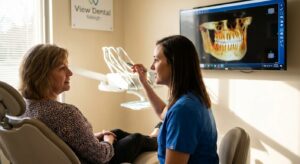

Roughly 36% of American adults experience significant dental fear, and about 12% avoid the dentist entirely because of it. If you recognize yourself in those numbers, this guide covers everything you need to know about how to overcome fear of the dentist: what causes it, how it compounds over time, and the specific tools that work, from what to say before you sit in the chair to clinical sedation options to therapies that reduce fear at its root.
What to Expect in This Guide
- Why dental fear exists and why it’s a recognized psychological response
- The four core fear triggers and the research behind each one
- How avoidance damages your whole body, not just your teeth
- How to find the right provider and what to ask before you book
- Relaxation techniques with measurable effects on anxiety
- Sedation options from lightest to deepest
- Cognitive and behavioral approaches for lasting change
- Practical strategies for the day itself, including help for children
What Dental Fear Actually Is (And Why It’s More Common Than You Think)
Dental fear sits on a spectrum. On one end, there’s mild nervousness before a checkup, the kind most people shake off once they’re in the chair. On the other end sits dentophobia, a diagnosable specific phobia where the anticipation of a dental appointment triggers the same physiological cascade as a genuine threat: elevated heart rate, cortisol surge, avoidance behavior. According to a 2022 systematic review published in the Journal of Dental Research, between 15% and 20% of adults in high-income countries meet clinical criteria for dental anxiety, with roughly 4-5% qualifying as truly phobic.
Dental fear is a recognized psychological response, not a personality flaw or a sign of weakness. The brain’s threat-detection system doesn’t distinguish well between a perceived danger and a real one, and for many people, the dental chair has been associated with genuine pain, loss of control, or humiliation. That association is real, it’s wired in, and it’s treatable.
The Real Reasons People Fear the Dentist
Fear of the dentist rarely has a single cause. Most anxious patients carry a combination of triggers, and understanding which ones are driving your response is the first step toward dismantling them.
Fear of Pain
A 2015 study published in Pain found that anticipatory anxiety about pain activates the same neural regions, including the anterior cingulate cortex, as pain itself. Your brain begins responding to the threat before anything has happened. For dental patients, this means the anticipation of a needle or drill can produce a stress response that exceeds the actual discomfort of the procedure.
Much of this fear is built on outdated information. Dental anesthesia has changed dramatically over the past two decades. Buffered anesthetic, which neutralizes the acidity of the injection solution, makes the numbing process significantly more comfortable. Many patients who expect sharp injection pain are surprised to feel almost nothing. The practical step here: before your appointment, ask specifically how the practice manages injection discomfort and whether buffered anesthesia is available.
Fear of Losing Control
A 2011 study in the European Journal of Oral Sciences surveyed 500 dental patients and found that perceived helplessness, specifically the inability to stop or pause a procedure, was the strongest predictor of anxiety severity among all fear subtypes. Being reclined in a chair with instruments in your mouth while someone works above you is a genuinely vulnerable position, and the brain reads vulnerability as danger.
The most effective single tool for restoring a sense of control is the stop signal: before treatment begins, agreeing on a hand gesture that pauses everything immediately. No questions asked. No need to explain. This one agreement changes the dynamic of the entire appointment because it gives you a real exit that you can use at any moment.
Embarrassment About Dental Health
A 2019 survey by the British Dental Association found that among patients who had delayed dental care for five or more years, shame about the current state of their teeth was cited as a barrier to seeking care by 65% of respondents. This creates a self-reinforcing loop: fear causes avoidance, avoidance allows problems to worsen, worsening problems deepen shame, and deepening shame makes the next appointment feel even more impossible.
Here’s what breaks that loop: dentists see every degree of neglect every single day. A compassionate provider is not looking at your mouth and forming a judgment about your character. They’re assessing what needs to be done and in what order. When a patient arrives after years away and tells a caring provider they’re embarrassed, the right response, and the one you deserve, is “I’m glad you’re here.” Nothing more.
Trauma From a Past Experience
A genuinely painful, rushed, or dismissive dental appointment doesn’t just leave a bad memory. A 2014 study in the European Journal of Oral Sciences found that recalled dental pain tends to be amplified over time due to memory consolidation processes, meaning the experience in your memory is often more intense than what actually occurred. A difficult appointment at age eight can anchor a fear response that persists for decades.
The encouraging counterpoint: memory consolidation works in both directions. A single positive appointment with a different provider, one where you felt heard, comfortable, and in control, can begin to rewrite that association. It doesn’t undo the original experience, but it creates a competing association that weakens the original fear response with each subsequent visit.
How Dental Anxiety Damages More Than Your Teeth
The cost of dental avoidance extends well beyond the mouth. Understanding the full picture makes treating dental anxiety a genuine health priority.
The Oral Health Consequences of Avoidance
Clinically, the damage from skipped preventive care follows a predictable trajectory. A cavity that takes twenty minutes to fill if caught early becomes a root canal if left untreated. Mild gum inflammation that reverses with a professional cleaning becomes periodontitis that requires surgery. A 2020 study in the Journal of Dental Research found that patients with high dental anxiety presented with significantly worse oral health outcomes on average, including higher rates of tooth loss and untreated decay, compared to low-anxiety controls.
The irony is direct: the longer you avoid the dentist because you fear painful treatment, the more likely it is that the treatment you eventually need will be extensive. Avoidance increases the very thing you’re afraid of.
The Whole-Body Cost
Periodontal disease, the chronic bacterial infection of the gum tissue, is an independent risk factor for cardiovascular disease and stroke. A 2018 meta-analysis in Atherosclerosis found that individuals with periodontitis had a 24% higher risk of coronary artery disease compared to those without. Untreated dental infection also worsens glycemic control in diabetic patients, and systemic inflammation from oral bacteria has been linked to adverse pregnancy outcomes.
Treating dental anxiety isn’t just about comfort. It’s about reducing a genuine systemic health risk.
How to Find the Right Dentist When You Have Anxiety
Every other tool in this guide depends on having a provider who actually takes fear seriously. The right dental office changes the entire experience for patients who come in anxious and ashamed. The wrong one confirms everything you were afraid of.
Look for practices that mention anxiety management explicitly on their website, that offer a no-treatment consultation, and that describe their communication approach in terms that sound patient-led rather than procedurally efficient. Pay attention to whether the front desk team sounds unhurried when you call.
Questions to Ask Before You Book
Call the office before booking and ask these specific questions. Listen to how they answer, not just what they say.
Ask whether they offer a consultation appointment with no treatment on that visit. A practice willing to spend time just listening is signaling its priorities. Ask what sedation options they have available, because a range of options suggests they see anxious patients regularly. Ask whether you can establish a stop signal before treatment begins. The right answer is immediate and matter-of-fact: “Absolutely, we do that with every patient.” Ask how they typically handle a patient who hasn’t been in for several years and is embarrassed about their teeth. The answer should feel warm and non-judgmental, not scripted. Finally, ask how they communicate during a procedure, whether they narrate each step before doing it. A provider who explains as they go eliminates the fear of the unknown in real time.
What a Good First Appointment Should Look Like
A first appointment for an anxious patient should involve no drilling, no pressure, and ideally, no treatment at all. It’s a conversation. A look around the mouth. A chance to understand what’s going on and build a plan together.
This is directly supported by exposure therapy research. A 2010 study in Behaviour Research and Therapy found that for phobic patients, graduated exposure, starting with the least threatening contact and building incrementally, produced significantly better treatment completion rates than standard appointments that moved straight into clinical work. The low-stakes first visit isn’t a courtesy. It’s the most effective clinical entry point for a fearful patient.
Relaxation Techniques That Work Before and During the Appointment
These aren’t vague wellness suggestions. Each technique has measurable effects on anxiety markers like cortisol levels and heart rate variability.
Controlled Breathing
A 2017 study in Frontiers in Psychology measured the physiological effects of slow diaphragmatic breathing in acutely anxious individuals and found significant reductions in salivary cortisol and self-reported anxiety within five minutes. The specific pattern with the strongest evidence is the 4-7-8 technique: inhale for 4 counts, hold for 7, exhale slowly for 8. The extended exhale activates the parasympathetic nervous system, which is the system responsible for calming the stress response.
Use it in the waiting room. Use it during pauses in treatment. The action is simple: practice it twice before your appointment so it’s automatic when you need it.
Muscle Relaxation and Grounding
A 2016 randomized controlled trial published in the European Journal of Dental Education found that progressive muscle relaxation reduced pre-procedure anxiety scores by a clinically meaningful margin compared to a control group. The technique involves systematically tensing and releasing muscle groups, starting from the feet and working upward, while seated in the dental chair.
It works because it gives the body something to do with the physical tension that anxiety creates. Start at your feet: tense the muscles hard for five seconds, then release completely. Move to your calves, then thighs, then abdomen. By the time you reach your shoulders, most of the held tension has already discharged.
Distraction That Actually Helps
A 2016 study in the Journal of Dental Hygiene found that patients who listened to self-selected music through headphones during dental procedures reported significantly lower anxiety levels compared to patients in a control condition. The neurological mechanism is straightforward: auditory attention competes directly with the threat-monitoring loop that drives dental fear. When your brain is tracking a song, it has fewer resources available to catastrophize.
Bring headphones to your next appointment. Build a playlist in advance, something familiar and absorbing, so you’re not searching under stress. Many practices now offer video glasses that connect to your phone or tablet so you can watch a movie or show during treatment. Ask whether this is available when you book.
Talking to Your Dentist: The Communication Moves That Change Everything
A 2012 study in the International Journal of Paediatric Dentistry found that patients who disclosed their anxiety to their dental provider before treatment began rated the experience as significantly less distressing and were more likely to complete the full course of planned care. Communication with your dentist is a clinical tool.
Establishing a Stop Signal
Before any instrument enters your mouth, agree on a hand signal that stops everything immediately. Raise your left hand: treatment pauses. No explanation needed. A 2014 study in the European Archives of Paediatric Dentistry found that patients given a perceived control mechanism before dental procedures reported lower anxiety both during and after the appointment.
The signal works because it makes the exit real. As long as stopping feels theoretically possible but not actually sanctioned, the brain continues to monitor for threats. A genuine, pre-agreed signal shifts that calculus.
Telling the Dentist Your History
“I’m nervous” is helpful. “I had a painful extraction at fourteen with inadequate anesthesia, and I have a strong gag reflex” is actionable. Dentists adjust technique based on specific, known triggers. Vague anxiety is harder to accommodate than a named fear.
Write it down before the appointment so you don’t have to reconstruct it under stress. One sentence per trigger is enough. Hand it to the provider before they begin. That piece of paper tells them what to watch for and signals that you’re a thoughtful patient who wants to collaborate rather than endure.
Sedation and Medication Options: What’s Available and When to Use Each
Sedation isn’t a last resort for patients who can’t cope. It’s a clinical tool that allows necessary treatment to happen. Here are the options, from lightest to deepest.
Nitrous Oxide (Happy Gas)
Nitrous oxide is inhaled through a small mask over the nose and takes effect within two to three minutes. It produces a mild floating sensation, reduced sensitivity to discomfort, and a general sense of calm. When the mask is removed, the effect clears within five minutes, meaning you can drive yourself home afterward.
A 2019 Cochrane review on pharmacological interventions for dental anxiety found that nitrous oxide was effective for mild-to-moderate anxiety and significantly improved treatment completion rates compared to no sedation. Ask during your booking call whether it’s available and factor that into your choice of practice.
Oral Sedation
Oral sedation involves taking an anti-anxiety medication, typically a benzodiazepine, one hour before the appointment. The effect ranges from mild relaxation to moderate sedation depending on the dose. You remain conscious and responsive, but the anxiety response is substantially blunted.
A 2020 study in Anesthesia Progress found that oral sedation enabled patients with severe dental anxiety to complete procedures they had previously cancelled entirely. You’ll need a driver. Plan to rest for the remainder of the day. But for patients whose fear has historically caused them to cancel at the last minute, oral sedation can be the intervention that breaks the avoidance cycle.
IV Sedation and General Anesthesia
IV sedation delivers sedative medication directly into the bloodstream, producing deep relaxation with partial consciousness. Most patients have little to no memory of the procedure. General anesthesia produces full unconsciousness and requires a specialist setting.
Both options exist for patients with severe phobia or those requiring extensive treatment in a single session. These are not failure states. They are appropriate clinical choices for specific situations, and knowing they exist removes the feeling that there’s no option if other approaches aren’t enough.
Cognitive and Behavioral Approaches for Long-Term Relief
Sedation manages an appointment. Cognitive and behavioral therapies reduce the fear itself over time. These are the only interventions with strong evidence for lasting change in dental phobia.
Cognitive Behavioral Therapy (CBT)
A 2012 Cochrane review analyzing trials of psychological interventions for dental phobia found that CBT produced the largest and most durable reductions in dental fear across all reviewed approaches. CBT targets the thought patterns that transform a routine appointment into a catastrophic event: the belief that pain is inevitable, that the dentist will judge you, that you’ll lose control and embarrass yourself.
In practice, a CBT therapist helps you identify those automatic thoughts, test them against evidence, and replace them with more accurate interpretations. Ask a general practitioner for a referral to a CBT practitioner with experience in medical or procedural phobias.
Systematic Desensitization
Systematic desensitization works by pairing progressive exposure to feared stimuli with a relaxation response. The hierarchy starts with simply imagining a dental office while practicing controlled breathing, then moves to visiting an office with no appointment, then sitting in the chair, then allowing examination, then allowing treatment.
A 2009 study in Behaviour Research and Therapy found that graduated exposure produced measurable reductions in phobic avoidance behavior in 87% of participants over a six-to-eight week protocol. You can work through a simplified version of this hierarchy on your own, or with the support of a therapist. The practical steps for tackling anxiety before and during treatment often build on this same graduated logic.
Hypnotherapy
Clinical hypnotherapy for dental anxiety is not the stage-show version. It’s a focused relaxation state in which the therapist delivers suggestions that alter how the patient relates to dental stimuli. A 2016 review in the International Journal of Clinical and Experimental Hypnosis found that hypnotherapy produced significant reductions in dental anxiety scores across multiple controlled trials.
It works best as a complement to other approaches rather than a standalone intervention. Combined with CBT or systematic desensitization, it can accelerate the reduction of the fear response.
Practical Strategies for the Day of the Appointment
The logistics surrounding an appointment carry their own anxiety load. These moves reduce it before you ever sit in the chair.
Arrive Early, Not Just on Time
A 2015 study in Psychoneuroendocrinology found that rushed arrival before medical procedures elevated baseline cortisol significantly compared to calm arrival with buffer time. Cortisol is the primary stress hormone, and starting an appointment with it already elevated means you’re fighting a two-front battle.
Schedule your arrival time in your calendar, not your appointment time. Fifteen minutes of sitting, breathing, and adjusting to the environment lets the nervous system settle before treatment begins.
Bring a Support Person
A 2010 meta-analysis in Health Psychology found that social support from a companion reduced perceived pain and self-reported anxiety in clinical settings across multiple procedure types. A familiar, calm presence changes the physiology of the experience.
Ask in advance whether a support person can sit with you in the treatment room. Many practices allow this for anxious patients. If a companion in the chair isn’t possible, even having them in the waiting room is worth the logistics.
Schedule Strategically
Morning appointments reduce the all-day anticipatory dread that builds when you’re counting hours until a late-afternoon slot. A 2014 study in Psychosomatic Medicine found that cortisol reactivity to stressors is higher in the afternoon, meaning your anxiety response is physiologically amplified later in the day.
Tuesday or Wednesday slots tend to work better than Monday, when residual weekend disruption still sits in the nervous system. These are small adjustments, but stacked together, they reduce the total anxiety load you walk in with.
Helping Children Overcome Fear of the Dentist
Childhood dental anxiety is the strongest predictor of adult dental phobia. What happens in those first appointments sets the template for every appointment that follows.
Starting Early With Positive Experiences
A 2012 study in the European Archives of Paediatric Dentistry found that children whose first dental visit occurred before age three had significantly lower anxiety scores at subsequent appointments compared to children whose first visit happened later, after fear had already developed around the unknown.
The first visit should involve no pressure and no procedures beyond a look around the mouth. The show-tell-do technique, where the dentist shows a child each instrument, explains what it does, and demonstrates it before using it, is standard in pediatric dentistry for a reason. It converts the unfamiliar into the known.
What Parents Should (and Shouldn’t) Say
“It won’t hurt” signals to a child’s brain that hurting is a possibility worth monitoring for. “Be brave” communicates that danger exists and that they’re expected to suppress their response to it. A 2008 study in Behaviour Research and Therapy found that parental anxiety about dental visits transferred directly to child fear responses, measured by both self-report and cortisol levels.
Replace threat-implying reassurance with neutral, matter-of-fact framing: “The dentist is going to count your teeth.” “They’re going to use a little mirror to look around.” Before the appointment, examine your own language and your own visible anxiety. Children read the adult in the room.
Frequently Asked Questions
How do I tell my dentist I’m scared without feeling embarrassed?
You don’t need to explain or justify it. Before the appointment begins, say directly: “I have significant anxiety about dental visits, and I want to talk about how we can manage that before we start.” A good provider will not react with impatience or dismissal. Write it down if saying it out loud feels too difficult, and hand it to the provider when they come in. You should be able to name your specific triggers too, whether that’s needles, the drill sound, or gagging, because named triggers give the dentist specific things to adjust.
Is dental anxiety the same as dental phobia?
They’re on the same spectrum but differ in severity. Dental anxiety involves heightened nervousness before and during appointments. Dental phobia is a diagnosable specific phobia characterized by intense, irrational fear that causes active avoidance regardless of dental need. Someone with dental anxiety may still attend appointments while dreading them. Someone with dental phobia typically avoids the dentist entirely, even when in pain.
What if I’ve been avoiding the dentist for years and my teeth are in bad shape?
This is more common than you think, and a compassionate practice expects it. The immediate priority isn’t fixing everything, it’s addressing what’s causing pain or infection first. Most providers who work with anxious patients build a staged treatment plan: urgent problems first, then restoring function, then longer-term care. The fact that significant time has passed doesn’t change the approach; it just means the plan covers more ground.
Does sedation make dental treatment safe for people with extreme fear?
For patients with severe phobia, sedation isn’t just comfortable, it’s often what makes safe, complete treatment possible. Untreated dental infection carries genuine medical risks. Nitrous oxide and oral sedation are both well-established, with strong safety profiles for otherwise healthy adults. IV sedation and general anesthesia require specialist oversight but are appropriate for specific situations. Discuss your medical history with the provider before any sedation is administered.
How long does it take to overcome dental phobia completely?
It depends on the severity of the phobia and the approach. Patients who complete a course of CBT or systematic desensitization typically see meaningful reductions in fear within six to twelve weeks. Clinically, many patients report a significant emotional shift after just one appointment where they felt genuinely heard and where physical discomfort was effectively managed. Fear that has built over decades doesn’t resolve overnight, but the direction of change can begin after a single positive experience.
Can children take medication for dental anxiety?
Yes, pediatric practices commonly use nitrous oxide for children with significant anxiety, and it’s considered very safe in that population. Oral sedation and deeper sedation options are available for children in specialist settings when treatment is complex or fear is severe. The first line of intervention for children is always behavioral, meaning the show-tell-do approach, gradual exposure, and a provider trained in pediatric anxiety, before medication is considered.
The First Call Is the Move That Starts Everything
The shift from dental fear to dental confidence doesn’t happen in a single appointment. But it starts with one phone call. This week, call one dental office and ask how they handle patients who come in anxious or who haven’t been in for years. Ask about sedation options, stop signals, and whether a first appointment can involve no treatment at all. Listen to how they respond.
If the answer feels rushed, dismissive, or scripted, call another office. The right fit exists, and you’ll recognize it when you hear it. That first call is the only thing on your list.